
Chlorophyll Fluorometers
OS1p
Chlorophyll Fluorometer
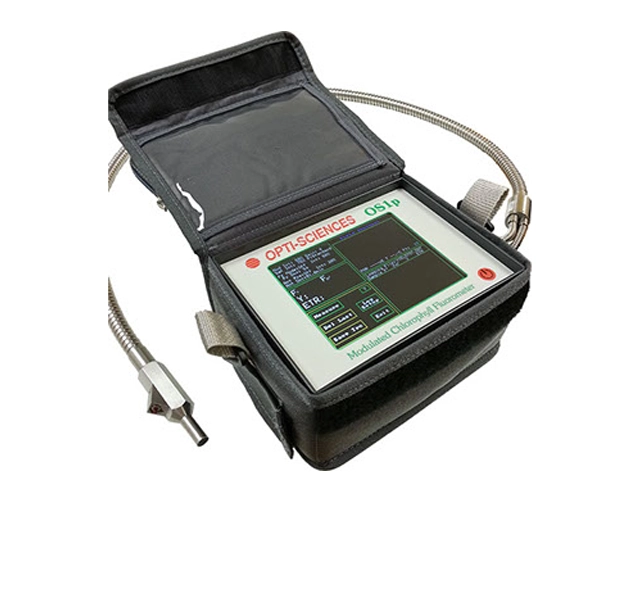
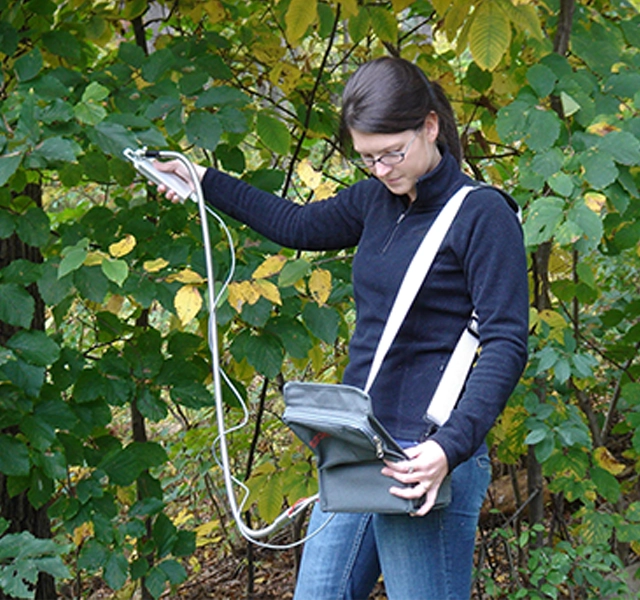
Best in class – measures Y(II), ETR, Leaf temp, FV/FM, quenching, & has FM‘ correction option included.
This instrument provides many plant stress measuring protocols, at a low price. OS1p capability includes the fast measurements: Y(II) or ΔF/FM‘, ETR, leaf temperature, and FV/FM. It also provides the Hendrickson lake model quenching protocol to allow NPQ, Y(NPQ), and Y(NO) measurements. Rapid light curves are also included.
The OS1p is designed to provide a cost effective, yet comprehensive plant stress measuring chlorophyll fluorometer. It is optimally designed to measure the light adapted protocol developed by Bernard Genty, ΔFM/FM‘ or Y(II), the Burke water stress assay, and the dark adapted protocols: FV/FM, Rapid Light Curves (for changing light conditions found under canopy and in aquatic measurements), and basic quenching measurement using the lake model Hendrickson protocol with NPQ, Y(NPQ) and Y(NO).
- Stable Internal Actinic Light Source for reliable field and laboratory quenching tests
- Loriaux (2013) FM‘ Correction Option or Square Topped Saturation Flash
- Optional PAR clip – Measures PAR , leaf temperature and can be used for ETR measurements
- Integrated GPS/GLONASS location receiver
- 6 – 8 hour battery charge life
- Automated modulated light set-up
- Menu driven color graphic touch screen interface.
- USB and removable SD memory card.
- Data is stored in comma delimited files
- Armored fiber optic light guide
Parameters Measured and Protocols included:
Y(II):
Quantum Photosynthetic Yield of PSII (or ΔF/FM‘ or Y(II)).
ETR:
Electron transport rate (w/optional clip).
PAR:
Photosynthetically Active Region value (with optional PAR clip).
T:
Leaf temperature (with optional PAR clip).
FV/FM:
Maximum Photochemical efficiency of PSII.
FV/FO:
A more sensitive detector of stress than FV/FM, but it does not measure plant efficiency.
FO:
Minimum fluorescence.
FM:
Maximal fluorescence.
FV:
Variable fluorescence.
FMS (or FM‘):
Maximal fluorescence with actinic illumination.
FS (or F):
Fluorescence under steady state conditions (prior to saturation pulse).
Multi-Flash with FM‘ correction and ETR correction.
RLC (Rapid light curves):
rETRMAX:
A measure of a leaf’s photosynthetic MAX capacity or maximum electron transport rate α is the initial slope of line at low PAR values created by relating ETR to PAR. It provides a measure of quantum efficiency.
Ik=rETRMAX/α:
A measurement of the light intensity where light saturation dominates, or the minimum saturation level.
I:
PAR light intensity at ETRMAX.
Quenching protocol:
Hendrickson lake model quenching protocol:
Y(NPQ), Y(NO), Y(II), NPQ, FV/FM.
Kramer Quenching (standard):
qL, Y(NPQ), Y(NO), Y(II), FV/FM.
Puddle model parameters (standard):
NPQ, qN, qP, Y(II), FV/FM.
Quenching relaxation protocol (standard):
qE, qM, qZ, qT, qI along with either puddle model, or Hendrickson parameters. Adjustable times for each.
Optional PAR Clip
Measures PAR and leaf temperature. It should be purchased for Y(II) and ETR measurements. The PAR Clip is also recommended for rapid light curves and quenching measurements because it allows the built-in actinic light source to remain at a stable light intensity during longer measurements.
Light Sources:
Saturation pulse:
White LED with 690nm short pass filter. 15,000 μmols.
Modulated light:
660nm LED with 690nm short pass filter.
Actinic light source:
White LED to 3,000 μmols.
Far red light:
720nm LED with > 700nm long pass filter.
Detection method:
Pulse modulation method.
Detector & Filters:
A PIN photodiode with a 700nm ~ 750nm bandpass filter.
Sampling Rate:
Auto-switching from 10 to 10,000 points per second, depending on phase of test.
Automated routine to optimally set the modulated light intensity.
The modulated light may also be set manually.
Multi-Flash FM‘ correction for all light adapted protocols.
It may be turned on or off.
Operational:
Test Duration:
Adjustable from 0.1 seconds to 12 hours.
GPS location:
Built in GPS / GLONASS 12 channel receiver with internal antenna.
Storage Capacity:
1 Gigabyte of non-volitile flash memory.
Digital Output:
USB removable storage device standard. Comma delimited files.
SD/MMC data card.
User Interface:
640 x 480 graphic color touch screen.
Menu driven software.
Power Supply:
Internal 12V, rechargeable nickel metal hydride battery.
Battery Life:
6 to 8 hours of continuous operation.
Dimensions:
7 in x 5.5 in x 3.25 in (17.8 cm, x 14 cm, 8.3 cm).
Weight:
3.6 lbs (1.62 kg)
Specifications subject to change without notice.
OS30p+
Handheld chlorophyll fluorometer
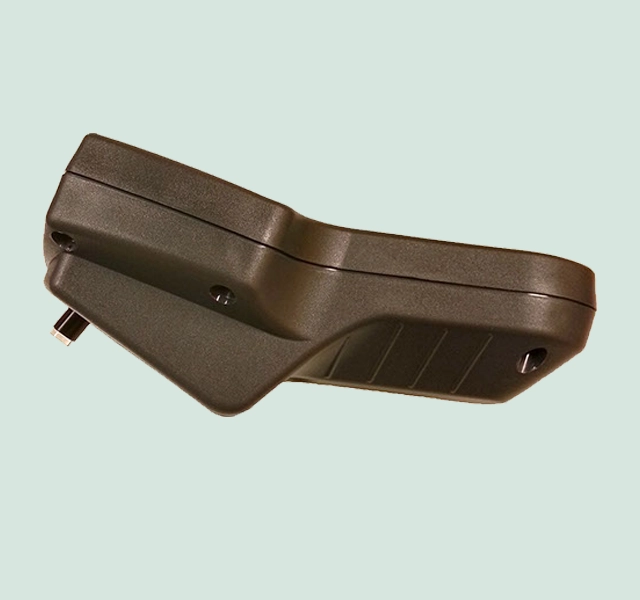
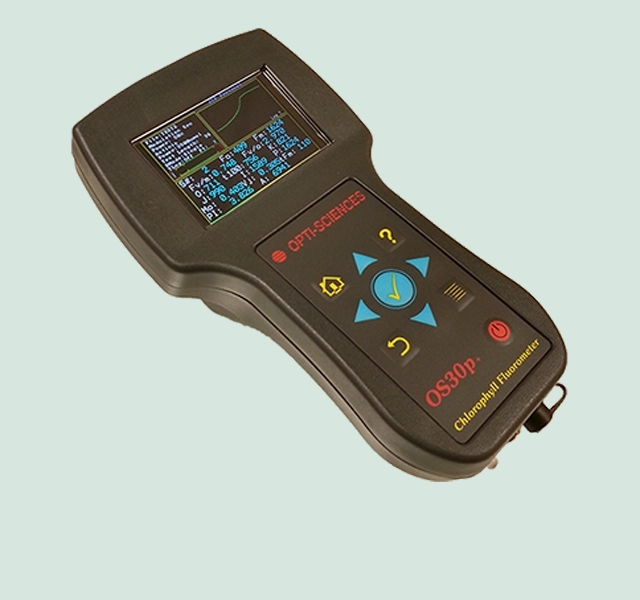
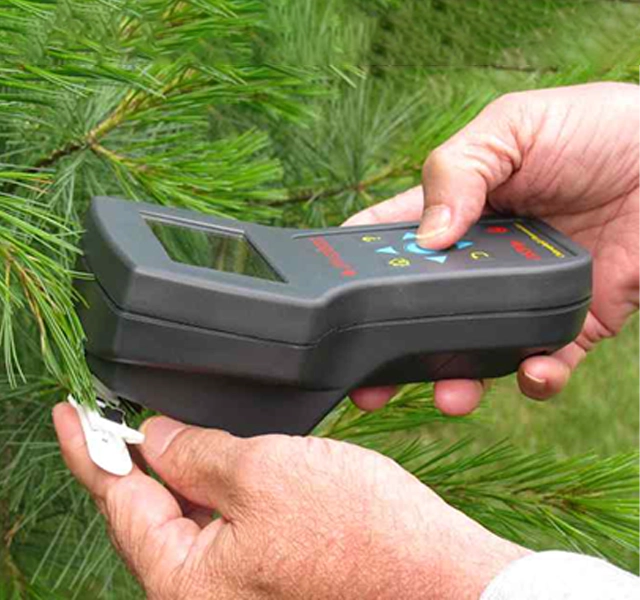
Provides the best of both worlds – FV/FM & calibrated Strasser OJIP measurements
The OS30p+ provides a graphic color display of both FV/FM protocol measurements & Strasser OJIP protocol measurements. FV/FM is the most used chlorophyll fluorescence measuring protocol in the world and the OS30p+ makes this and Strasser OJIP very affordable, in part, by elimination of an expensive fiber-optic light guide and the introduction of a short, dark clip friendly, optical probe.
The OS30p+ is a modulated fluorometer with a calibrated red actinic LED light source designed to provide optimal measurement of both FV/FM and Strasser protocol OJIP parameters. The instrument provides a graphic display for the FV/FM protocol and a color overlay display of OJIP graphs. Direct readout is available for FO, FM, FV/FM, & FV/FO. Direct readout is also available for the most used Strasser OJIP protocol parameters, including: PIABS, Vj, Mo, Area above the curve, O, t100, K, J, I, P, & tFM . All of the Strasser OJIP protocol parameters are reported & arranged in the data file for easy spider graphing and trace overlay graphing. Output is by USB port.
- Direct readout and graphic display of FV/FM and FV/FO measurements
- Self calibrating red Strasser OJIP light source at 3,500 μmoles – Because Strasser OJIP values change with actinic light intensity. 3,500 μmoles are recommended.
- Color graphic screen – allows multiple overlayed Strasser color graphs
- Direct readout of the most used Strasser protocol parameters including: O, t100, K, J, I, P, tFM, PIABS, Vj, MO, & A
- Print out of all of Strasser’s measuring parameters in the data file.
- Easy modulated light intensity set up with helpful intensity bar.
- Affordable dark adaptation clips
- USB port for easy data transfer
- Housekeeping automation reduces set up time and eliminates some types of measuring errors.
- Signal bar aides in modulated light intensity set up.
- Automated 8 point 25ms rolling average to determine maximum FM. This eliminates saturation pulse NPQ as a source of error if the saturation pulse is too long. This feature is only used in the FV/FM protocol.
- Automatic light calibration to 3,500 μmols.
FV/FM, FV/FO Test
Saturation intensity:
Adjustable from 600 – 6,000 μmols.
Saturation light source:
Array of 660nm red LEDs.
Modulated light source:
Adjustable from 0.1 to 0.6 μmols.
Detection method:
Pulse modulated using a PIN photodiode with 700-750 nm band pass filter.
Test duration:
0.1 seconds to 1.5 seconds. The default saturation pulse duration is set at 1.0 second. Software takes a rolling eight point average to determine FO, and FM, making it idea for both algae and land plants.
Parameters measured:
FO, FM, FV/FM, FV/FO, graphical display of trace.
Strasser OJIP Test
Actinic illumination:
An array of 650 nm red LEDs adjustable up to 6,000 μmols.
Detection method:
Pin photodiode detector with 700-750 nm band pass filter. Variable sampling rate based on test phase.
Test duration:
3 – 300 seconds.
Test parameters measured:
Direct readout parameters:
O, t100μs, t300μs (K), t2ms (J), t30ms (I), P, tFM, A (area above the curve), MO (RC/ABS), PIABS (performance index) FO, FM, FV/FM, FV/FO. FO is measured not estimated.
Additional recorded parameters:
ABS/RC, TRO/RC, DIO/CS, ETO/RC, TRO/ABS, ETO/TRO, ETO/CS, RC/CSO, RC/CSM, S, M, T.
Up to 32 traces can be overlaid on the graphic display screen, and up to 32 traces per file name can be stored. Colors start to repeat on the viewing screen after 16 traces are overlaid. If traces are not stored, thousands of measurement parameter sets can be stored in a single data file for spider graphing.
General
Display:
Color Graphic Display.
Storage Capacity:
Greater than 100,000 measurements. Up to 32 traces can be stored with one data file name. Hundreds of traces can be stored in multiple data files, with different names.
Digital output:
USB removable storage device standard. Comma delimited files.
Battery:
NiMH battery pack. Runtime of 8 hours between charges.
Dimensions:
20 X 10 X 8 cm (13 x 10.5 x 6 inches).
Weight:
0.6kg (1.25 lbs).
Hard shell transport case:
33 X 27 X 15 cm (13 x 10.5 x 6 inches).
2.0kG (4.3 lbs) with instrument and accessories.
Specifications subject to change without notice.
OS5p+
Chlorophyll Fluorometer
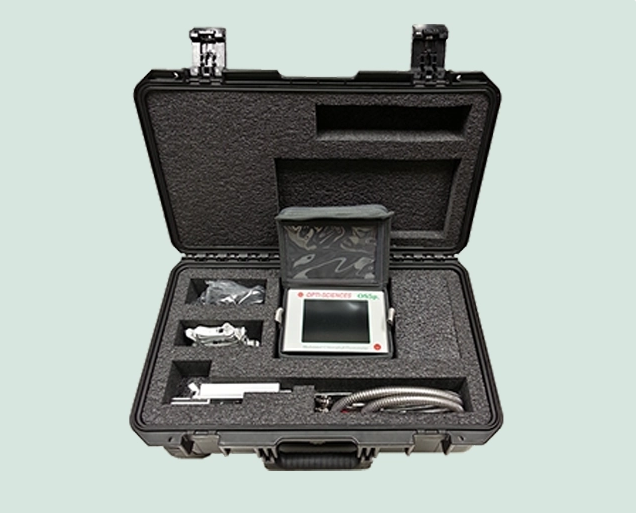
The most advanced portable modulated chlorophyll fluorometer available, with FM‘ correction option, according to Loriaux 2013, included for all light adapted protocols including quenching.
The OS5p+ portable system – includes the latest advancements in variable chlorophyll fluorescence measurements. The OS5p+ can measure most types of plant stress, and offers a wider range of up to date measuring protocols and automation.
The OS5p+ is designed to be the most advanced chlorophyll fluorometer available. It is intended for advanced plant research and plant stress measurement. It offers the latest updates in chlorophyll fluorescence capabilities, including: FM‘ correction according to Loriaux 2013, a stable white actinic white light source that allows chloroplast migration, and quenching relaxation measurement of qE, qT, qM, qZ, and qI. It also provides a comprehensive list of quenching protocols including Kramer lake model, Hendrickson lake model, and puddle model protocols. Other capabilities include: A Y(II) protocol, an FV/FM protocol, Strasser OJIP, Vredenberg OJIP, and Rapid Light Curves (for changing light conditions).
- Detection and Measurement of Most Types of Plant Stress
- Designed to allow & measure chloroplast migration qM
- Stable Internal Actinic Light Source for reliable field and laboratory quenching tests
- Loriaux (2013) FM‘ Correction Option or Square Topped Saturation Flash for all light adapted techniques including quenching
- PAR clip included – Measures PAR, leaf temperature, & ETR
- Integrated GPS/GLONASS location receiver
- 8 hour battery charge life
- Option for automated modulated light set-up
- Menu driven color graphic touch screen interface
- Data output via USB port and removable SD memory card
- Armored fiber optic light guide
Parameters Measured and Protocols included:
Y(II):
Quantum Photosynthetic Yield of PSII (or F/FM‘ or Y).
ETR:
Electron transport rate (w/optional clip).
PAR:
Photosynthetically Active Region value (with optional PAR clip).
T:
Leaf temperature (with optional PAR clip).
FV/FM:
Maximum Photochemical efficiency of PSII.
FV/FO:
A more sensitive detector of stress than FV/FM, but it does not measure plant efficiency.
FO:
Minimum fluorescence.
FM:
Maximal fluorescence.
FV:
Variable fluorescence.
FMS (or FM‘):
Maximal fluorescence with actinic illumination at steady state fluorescence.
FS (or F):
Fluorescence under steady state conditions (prior to saturation pulse).
RLC (Rapid light curves):
rETRMAX:
A measure of a leaf’s photosynthetic capacity or maximum electron transport rate a is the initial slope of line at low PAR values created by relating ETR to PAR. It provides a measure of quantum efficiency.
Ik=rETRMAX/α:
A measurement of the light intensity where light saturation dominates, or the minimum saturation level.
I:
PAR light intensity at ETRMAX.
Quenching protocol:
Hendrickson lake model quenching protocol:
Y(NPQ), Y(NO), Y(II), NPQ, FV/FM.
Kramer Quenching (standard):
qL, Y(NPQ), Y(NO), Y(II), FV/FM.
Puddle model parameters (standard):
NPQ, qN, qP, Y(II), FV/FM.
Quenching relaxation protocol (standard):
qE, qM, qZ, qT, qI along with either puddle model, or Hendrickson parameters. Adjustable times for each.
OJIP:
Up to 32 traces can be overlaid on the graphic display screen. The data file is designed for easy overlay graphing and spider plot graphing. Thousands of measurement parameter sets can be stored in a single data file for spider graphing. The number of data files are only limited by machine memory limits. FO is measured not estimated.
OJIP – Vredenberg OJIP quenching protocol:
Ft/FO.
OJIP – Strasser Protocol:
Direct readout of: OJIP t100μs, t300μs (or K step), tFM (or time to P or FM), A (or area above the curve), MO (or RC/ABS), PIABS (or performance index).
Strasser OJIP parameters reported to the data file only:
ABS/RC, TRO/RC, DIO/CS, ETO/RC, TRO/ABS, ETO/TRO, ETO/CS,RC/CSO, RC/CSM , S, M, T.
Light Sources:
Saturation pulse:
White LED with 690 nm short pass filter. 15,000 μmols, 7,500 μmols with PAR clip.
Modulated light:
Red: 660 nm LED with 690 nm short pass filter.
Actinic light source:
RGB light source with adjustable spectra. Intensity adjustable up to 6,000 μmols.
Far red light:
720 nm LED with >700nm long pass filter.
Detection method:
Pulse modulation method.
Detector & Filters:
A PIN photodiode with a 700 ~ 750 nm bandpass filter.
Sampling Rate:
Auto-switching from 1 to 10,000 points per second, depending on test & on phase of test.
Automated routine to optimally set the modulated light intensity. The modulated light may also be set manually.
Multi-Flash FM‘ correction for all light adapted protocols & quenching. It may be turned on or off.
Operational:
Test Duration:
Adjustable from .1 seconds to 12 hours.
GPS location:
Built in GPS / GLONASS 12 channel receiver with internal antenna.
Storage Capacity:
1 Gigabyte of non-volitile flash memory.
Digital Output:
USB removable storage device standard. Comma delimited files.
SD/MMC data card.
User Interface:
640 x 480 graphic color touch screen.
Menu driven touch screen.
Power Supply:
Internal 12V rechargeable nickel metal hydride battery.
Battery Life:
6 to 8 hours of continuous operation.
Dimensions:
7 in x 5.5 in x 3.25 in (17.8 cm x 14 cm x 8.3 cm).
Weight:
3.6 lbs (1.6 kg).
Operating temperature:
0 – 50oC, non condensing.
Specifications subject to change without notice.
FV/FM Meter
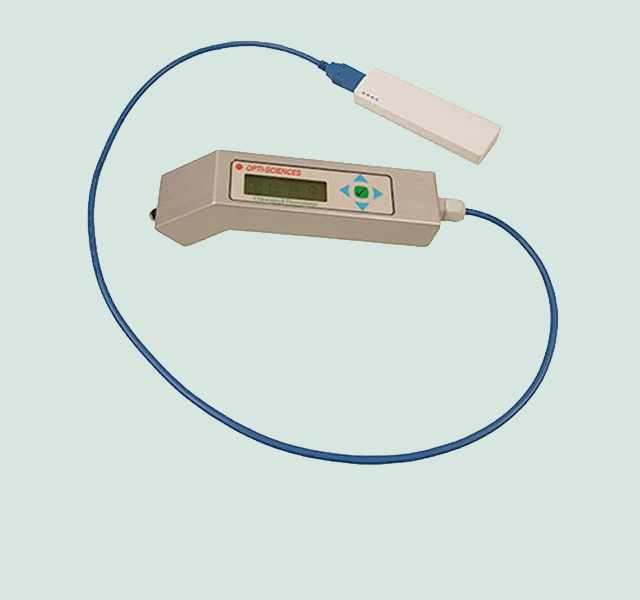
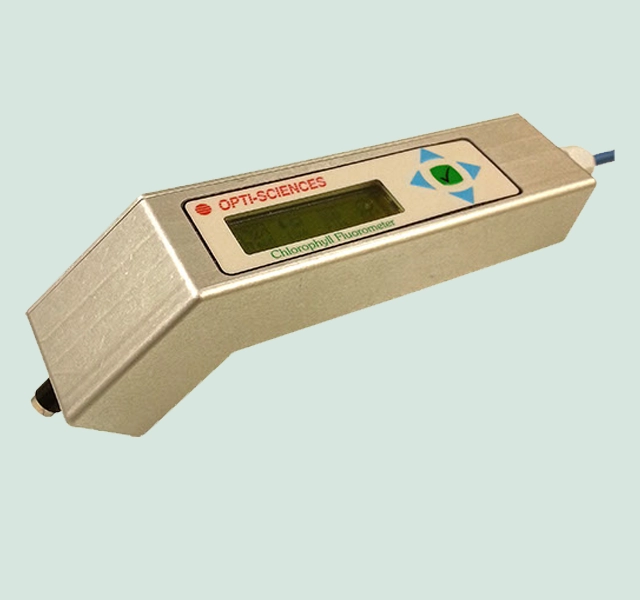
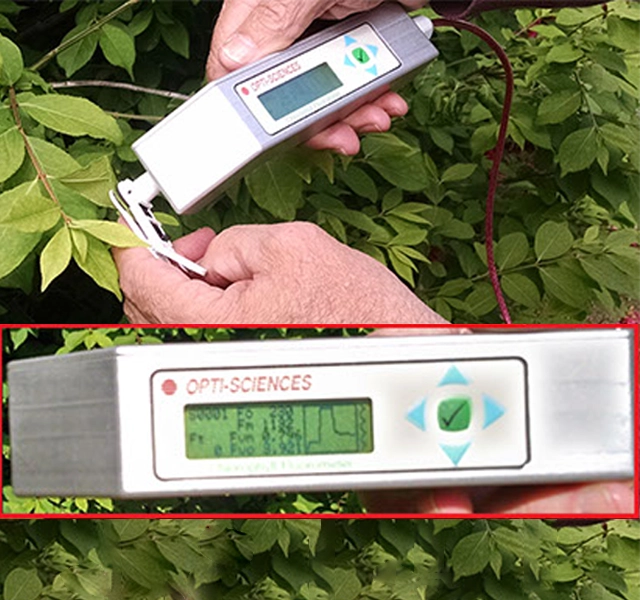
FV/FM is considered the gold standard of chlorophyll fluorescence measurement because it allows sample comparison at the same known common dark adaption state and measurements generally correlate to photosynthesis measurement. While healthy values vary by species between 0.79 to 0.84, lower FV/FM values indicate plant stress is affecting Photosystem II.
The FV/FM meter is most affordable modulated fluorometer for use with dark clips. FV/FM is the most used chlorophyll fluorescence measuring protocol in the world because it allows comparison of samples in the same known dark-adapted state. This allows comparison of samples where the light is changing. Samples can be compared under canopy or in situations where steady state photosynthesis is hard to measure. The FV/FM meter has an optical probe that permits measurement with dark adaptation clips, allowing fast measurement of large plant populations.
- Inexpensive dark adaption clips to allow rapid measurement of more statistically significant plant populations.
- Dark clips allow the equivalent of “predawn dark adaption measurement” at more reasonable hours of the day. They also allow dark adaption for shorter periods during the day.
- It comes standard with 10 dark clips (optional packages of 50 dark clips are available).
- Graphically displays FV/FM trace.
- Thousands of measurements may be stored.
- USB port for easy data transfer
- Optical probe to significantly reduce the cost of the instrument without sacrificing quality.
Fast measurements:
FV/FM , FV/FO, FO, & FM.
Light source:
Array of 660nm red LEDs.
Lighting conditions:
Dark adapted conditions only.
Light sources:
Red LED Saturation flash array up to 6,000 μmoles.
Red modulated light source (660nm with a 690nm cutoff filter).
Sensors:
Pin Photodiode with a 700nm to 750nm band pass filter.
Dark adaptation clips:
10 dark adaption clips are included.
Power:
Lithium-ion USB battery pack with 8 hour life. Designed to be carried in a pocket. The unit may be used with any USB compatible battery. The instrument will also run on most mains current USB chargers.
Size:
8.5″ x 1.125″ x 1.625″ (22 x 3 x 4 cm).
USB cable 32″ long, (81 cm).
Battery 4.5″ x 1″ x 1″ (12 x 2.54 x 2.54 cm).
Weight with battery 0.8 lbs (0.36 kg).
Storage capacity:
200,000 measurements.
Output:
USB removable storage device standard. Comma delimited files.
Graphic screen display:
132 X by 32 pixel LCD.
Specifications subject to change without notice.
Plant Stress Kit (PSK)
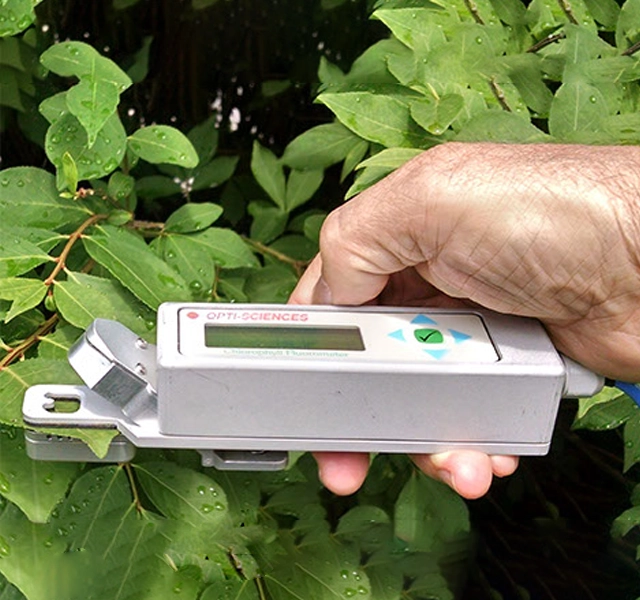
Y(II) meter: Measures light adapted Y(II) protocol with an FM‘ correction option, PAR, ETR, Leaf temp, & Leaf absorptance
FV/FM meter: Modulated fluorometer measures FV/FM
The Y(II) meter was designed to provide an inexpensive way to measure the fast light adapted Y(II) or ΔF/FM‘ protocol and to make it available to more people that need it.
Opti-Sciences developed a system that does not require expensive fiber optics, but still follows the proven methods needed for reliable plant stress measurement. Y(II) is measured from the top of the leaf along with PAR or photosynthetically active radiation. Furthermore, leaf temperature is measured from the bottom over a large area, allowing a more reliable value.
Measures the light adapted Y(II) protocol with an FM‘ correction option, PAR, ETR, Leaf temp, & Leaf absorptance.
FV/FM meter was designed to offer an inexpensive companion instrument to the Y(II) meter to allow measurement of the dark adaptated FV/FM protocol.
The Y(II) meter is a low cost portable field instrument that measures Bernard Genty’s fast light adapted parameter- ΔF/FM‘, ETR, PAR, leaf temperature, relative humidity, and leaf absorptance. By eliminating fiber optics, and using the latest LED technology, Opti-Sciences provides a durable instrument, based on hard science, without compromise. Y(II) is more sensitive to some types of plant stress than FV/FM. For example: Y(II) will detect heat stress at about 35oC while FV/FM will not detect heat stress until about 45oC. For more information, request the Opti-Sciences Plant Stress Guide on this website.
The FV/FM meter is companion instrument to the Y(II) meter that allow FV/FM measurements. When purchased together as the plant stress kit, there is a substantial savings compared to buying the FV/FM meter separately. FV/FM is the most used chlorophyll fluorescence measuring protocol in the world because it allows comparison of samples in the same known dark adapted state. This allows comparison of samples where the light is changing. While it is not as sensitive to some types of plant stress as the Y(II) meter, samples can be compared under canopy or situations where steady state photosynthesis is hard to measure. The FV/FM meter has an optical probe that permits measurement with dark adaptation clips, allowing fast measurement of large plant populations.
Y(II) meter
- The Y(II) meter may be purchased separately from the Plant Stress Kit
- Y(II) measurement & ETR measurement can be corrected for leaf absorptance
- Leaf absorptance measurement including leaf transmittance using RGB sensors
- PAR measurement
- Non Contact Leaf temperature measurement averaged over a large area
- FM‘ correction option at high actinic light levels, according to Loriaux 2013
- Diurnal monitoring capability designed for growth chamber work. It allows measurement day and night Useful for laboratory work
- Relative humidity sensor
- Data stored in comma delimited files
- USB port for easy data transfer
FV/FM meter
- Works with inexpensive dark clips to allow measurement of large populations quickly
- Graphic FV/FM trace display
- memory allows storage of tens of thousands of measurements
- Can be purchased separately from the Plant Stress Kit. USB port for easy data transfer
Y(II) Meter Specifications:
Fast measurements:
Y(II) or ΔF/FM‘ with the option for FM‘ correction according to Loriaux 2013 included. ETR, PAR, leaf temperature, relative humidity, leaf absorptance, FS, FM‘ and FT.
Monitor mode:
Measures the same sample for months at a time, using mains current. The monitor is designed for growth chamber, or laboratory work but not field work. The instrument can be programmed to measure at different intervals during light and dark periods. The monitor mode allows measurement of Y(II) or ΔF/FM‘, ETR, PAR, leaf temperature, relative humidity and leaf absorptance. From the dark period data, FV/FM, NPQ, Y(NPQ), and Y(NO) can be calculated.
Lighting conditions:
Ambient light only at steady state photosynthesis.
Light sources:
White LED saturation flash to 7,000 μmoles.
Red modulated light source (660nm with 690nm cut off filter).
Sensors:
2 RGB sensors for measurement of leaf reflectance, leaf transmittance, and leaf absorptance, calibrated with standard. From 0 to 100%.
PAR sensor measures from 400nm to 700nm, cosine corrected. +- 5%.
Pin Photodiode with a 700nm to 750nm band pass filter.
Relative humidity 0% to 100% +-2%.
Power:
Lithium-ion USB battery pack with 8 hour life. Designed to be carried in a pocket. The unit may be used with any USB compatible battery. The instrument will also run on most mains current USB chargers.
Size:
6.34″ x 1.5″ x 2.0″ (17 x 4 x 5 cm).
USB cable 32″ long (81 cm).
Battery 4.5″ x 1″ x 1″ (12 x 2.5 x 2.5 cm).
Weight with battery 0.8 lbs (0.36 kg).
Storage capacity:
200,000 measurements.
Output:
USB removable storage device standard. Comma delimited files.
Graphic screen display:
132 X by 32 pixel LCD.
FV/FM Meter Specifications:
Fast measurements:
FV/FM , FV/FO, FO, & FM.
Light source:
Array of red LEDs at 660nm.
Lighting conditions:
Dark adapted conditions only.
Light sources:
Red LED Saturation flash array up to 6,000 μmoles.
Red modulated light source (660nm with a 690nm cut off filter).
Sensors:
Pin Photodiode with a 700nm to 750nm band pass filter.
Dark adaptation clips:
10 dark adaption clips are included.
Power:
Lithium-ion USB battery pack with 8 hour life. Designed to be carried in a pocket. The unit may be used with any USB compatible battery. The instrument will also run on most mains current USB chargers.
Size:
8.5″ x 1.125″ x 1.625″ (22 x 3 x 4 cm).
USB cable 32″ long, (81 cm).
Battery 4.5″ x 1″ x 1″ (12 x 2.54 x 2.54 cm).
Weight with battery 0.8 lbs (0.36 kg).
Storage capacity:
200,000 measurements.
Output:
USB removable storage device standard. Comma delimited files.
Graphic screen display:
132 X by 32 pixel LCD.
Specifications subject to change without notice.