
LAND SEISMIC
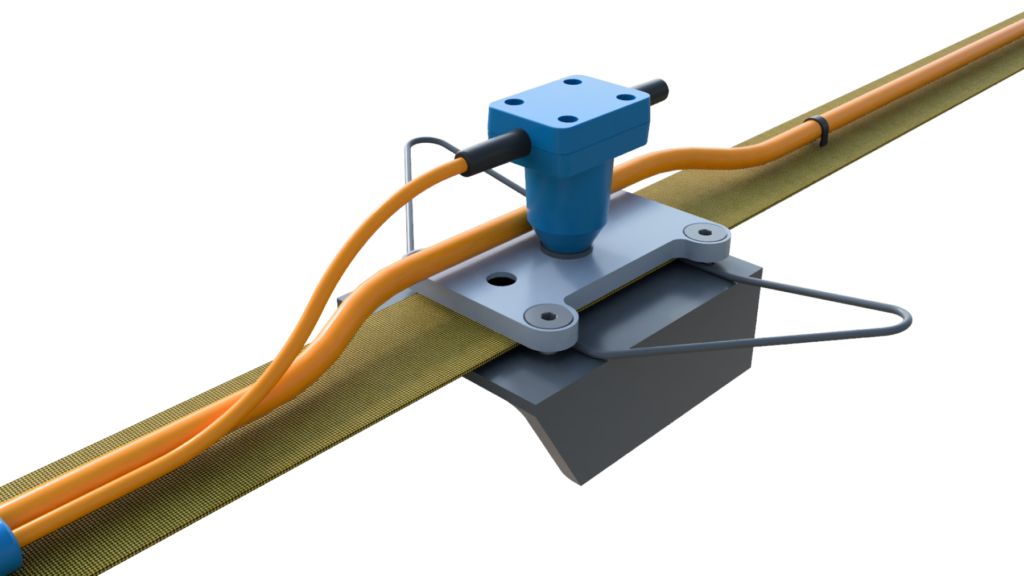
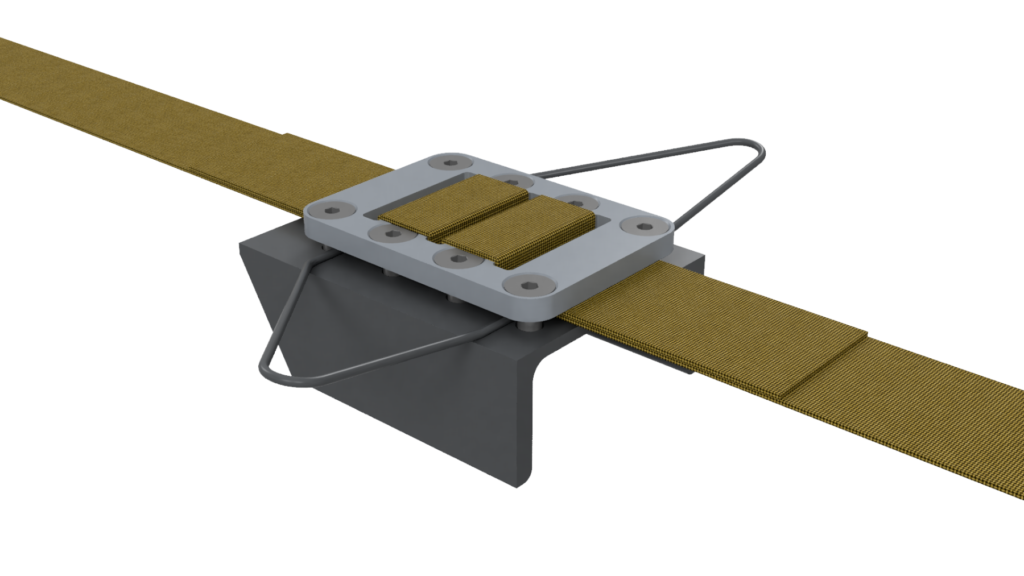
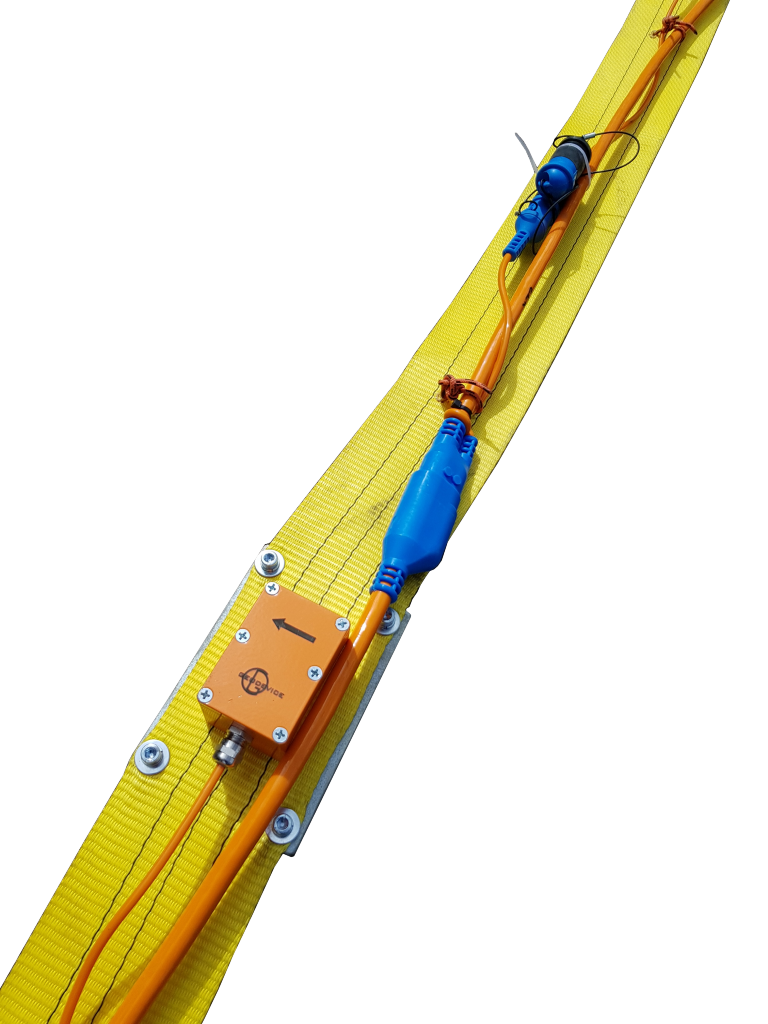
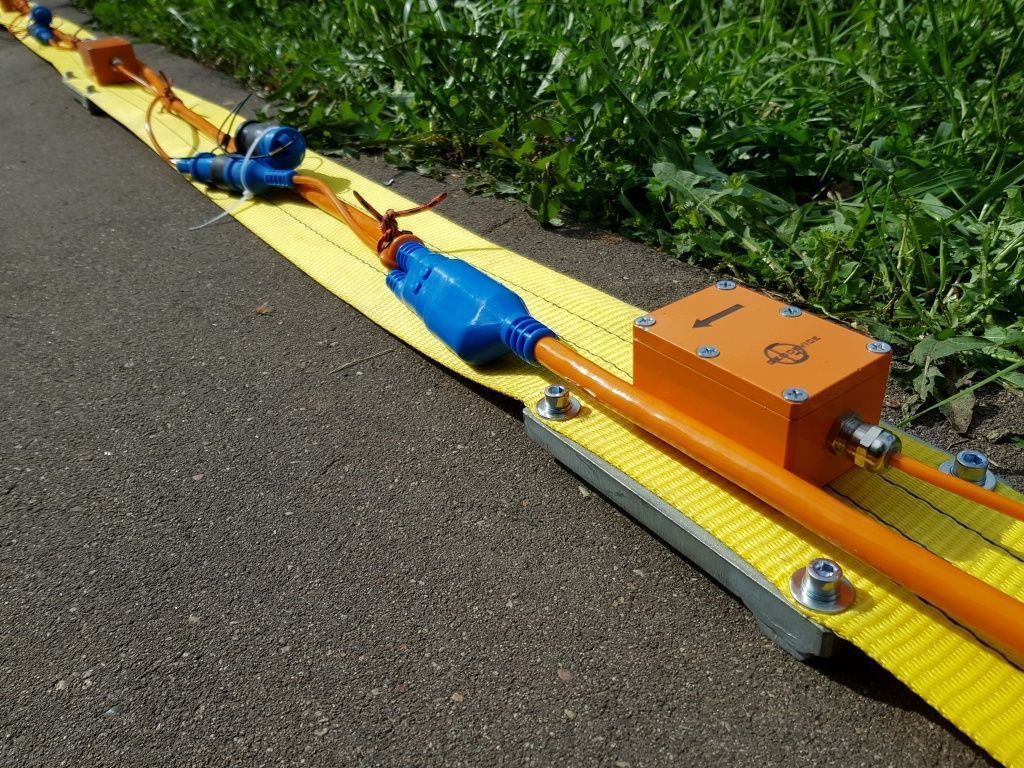
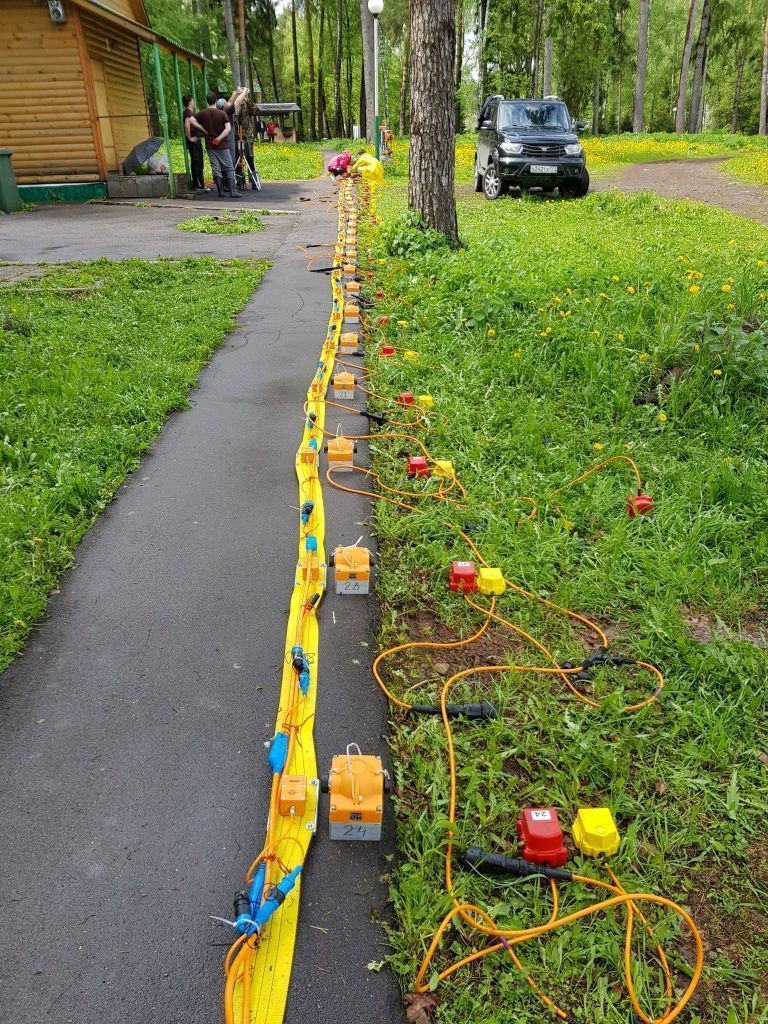
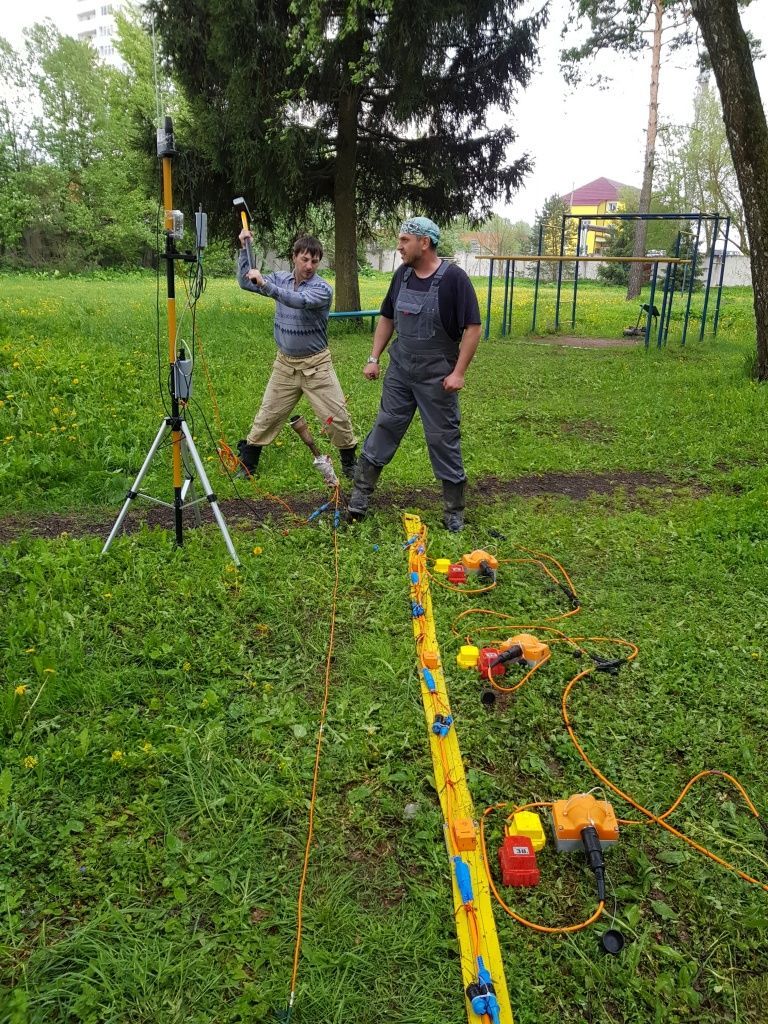
Towed LandStreamer for MASW, reflection or refraction surveys
Accelerated Weight Drop (AWD)-40PS
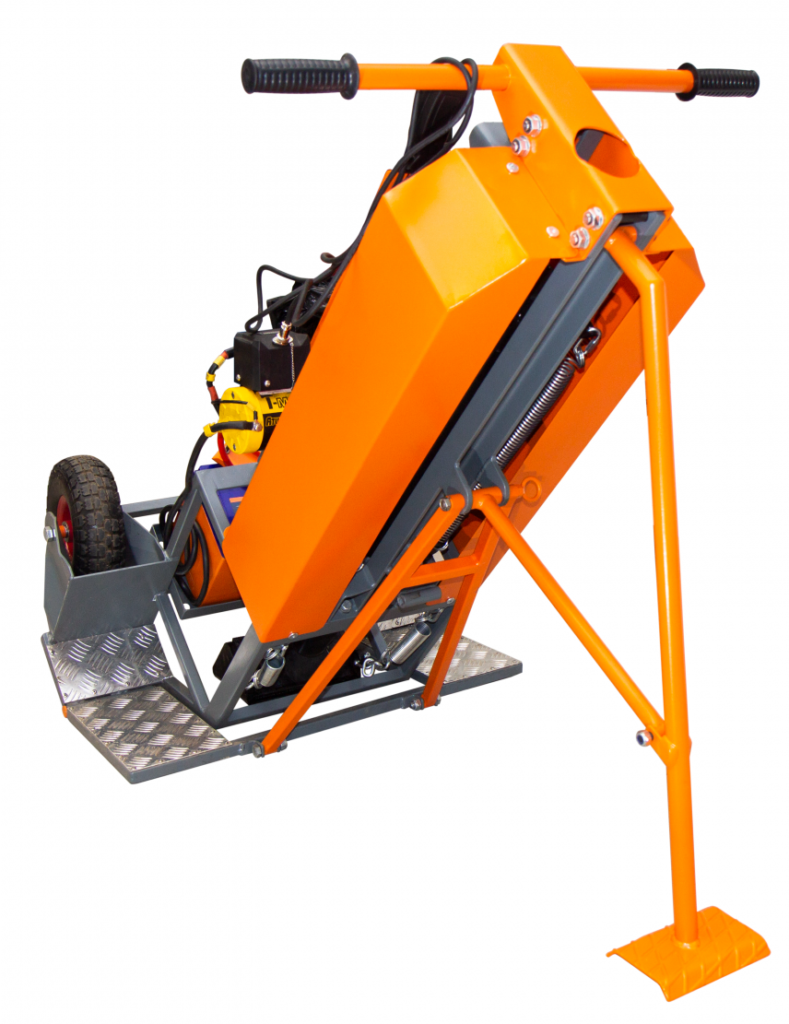
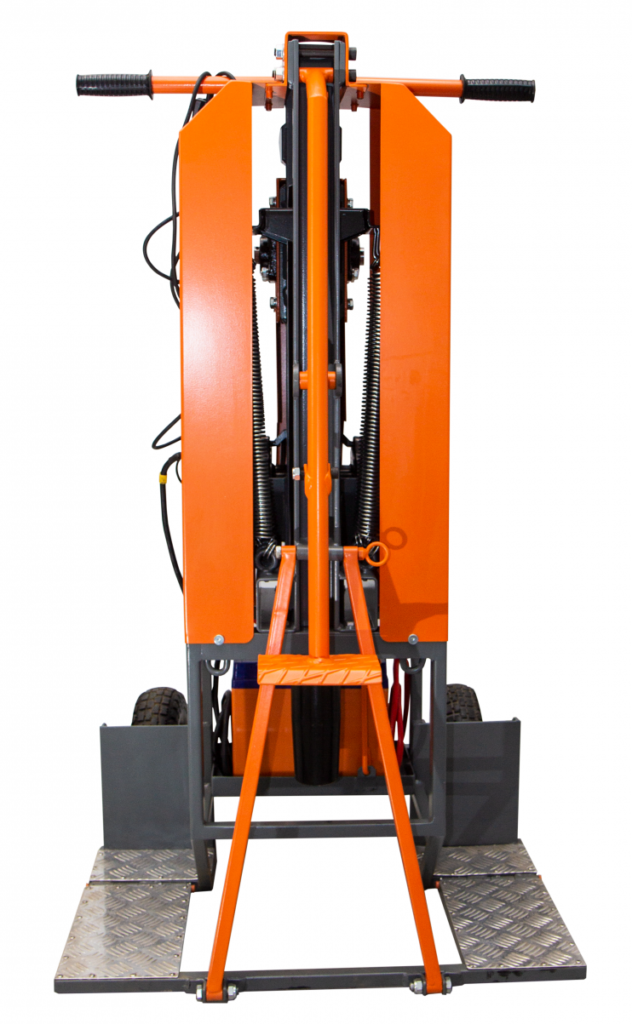
- P and S wave generation
- Compact design
- High energy of pulse
- Ideal repetition of impacts
- Hammers of different weights
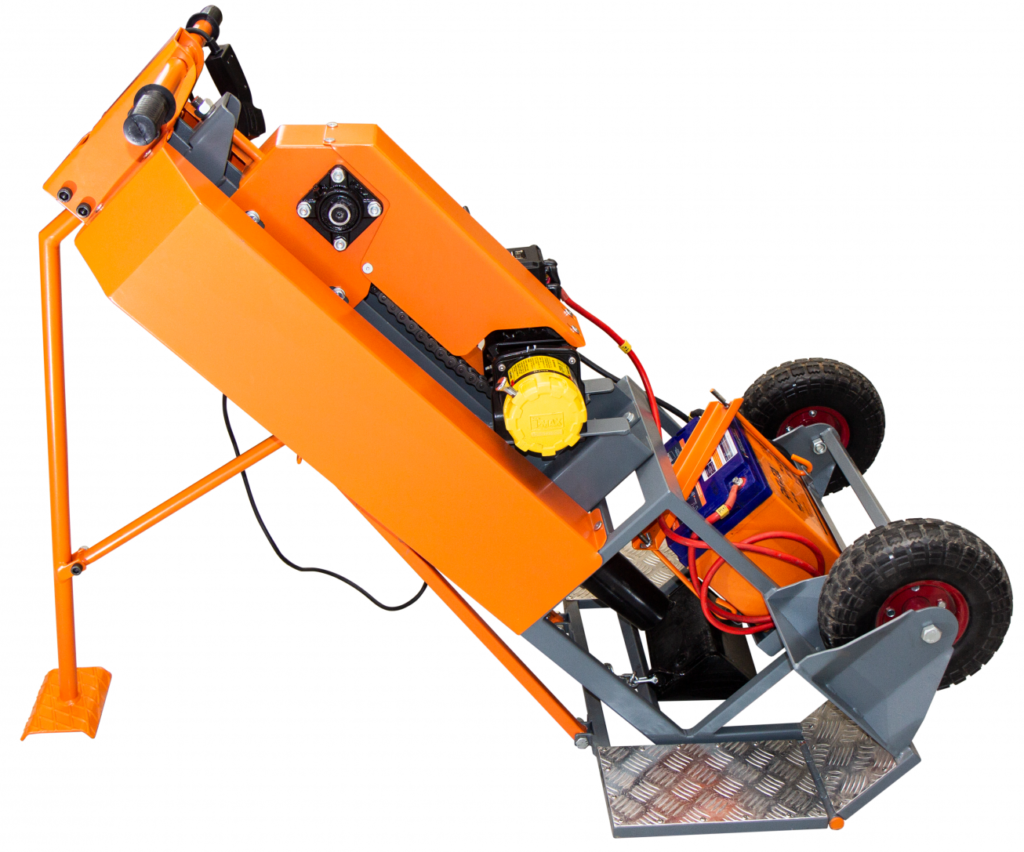
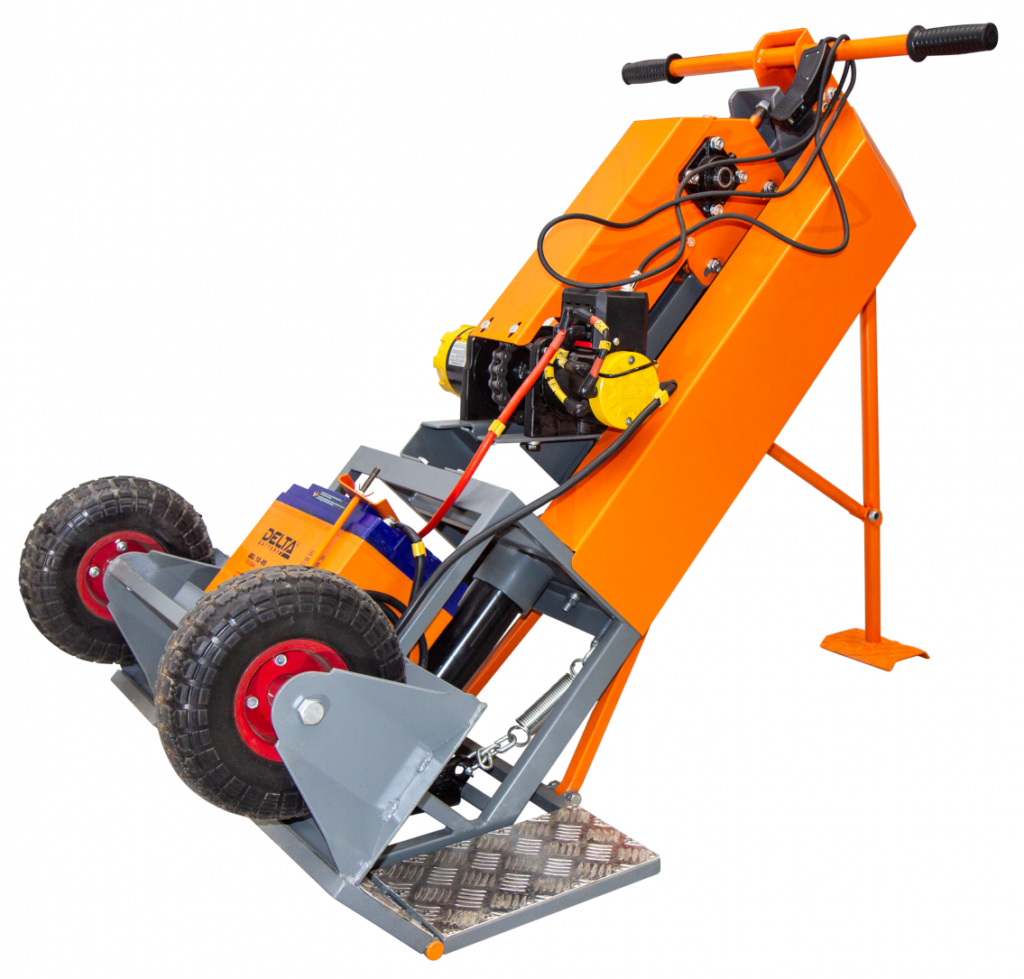
AWD-40PS is an accelerated weight drop seismic source designed for efficient generation of both P-waves and S-waves during land seismic surveys. The energy of a single impact reaches 1000 J.
AWD-40PS is available in two configurations:
- Cart-mounted version – fully self-contained mobile unit on a compact lightweight frame equipped with reliable wheel blocks. Designed for efficient generation of P and S waves on land seismic surveys.
- Tow-hitch mounted version (2” adapter) – can be mounted on a trailer, trunk of a pickup, a four-wheeler or a compact wheel pair (tow bar — four-square). Designed for efficient generation of P waves on land seismic surveys.
The cart version can additionally be equipped with a tow-hitch adapter, providing maximum flexibility of use.
The сart-mounted version AWD-40PS is with an inclined platform, allowing it to be installed at an angle of 45 degrees, and a special stop, adding stability in an upright position, what allows to perform survey on shear waves.
The system supports fast hammer replacement in the field and can operate efficiently in rugged terrain conditions. Total weight of the cart-mounted version (without battery pack) is less than 120 kg.
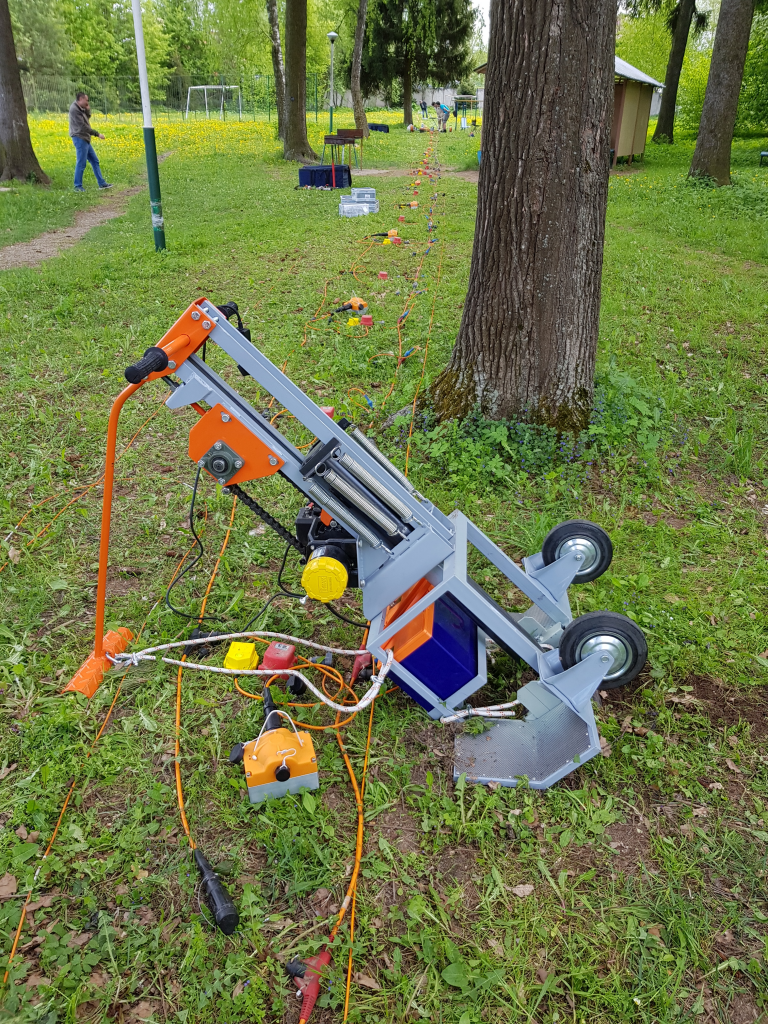
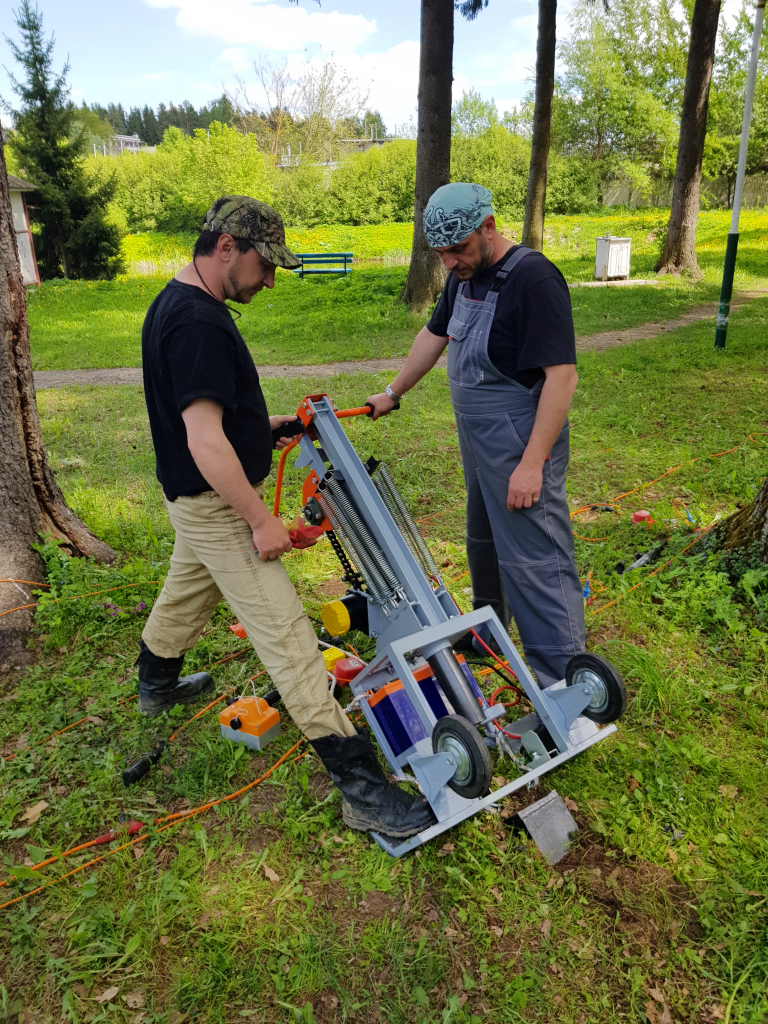
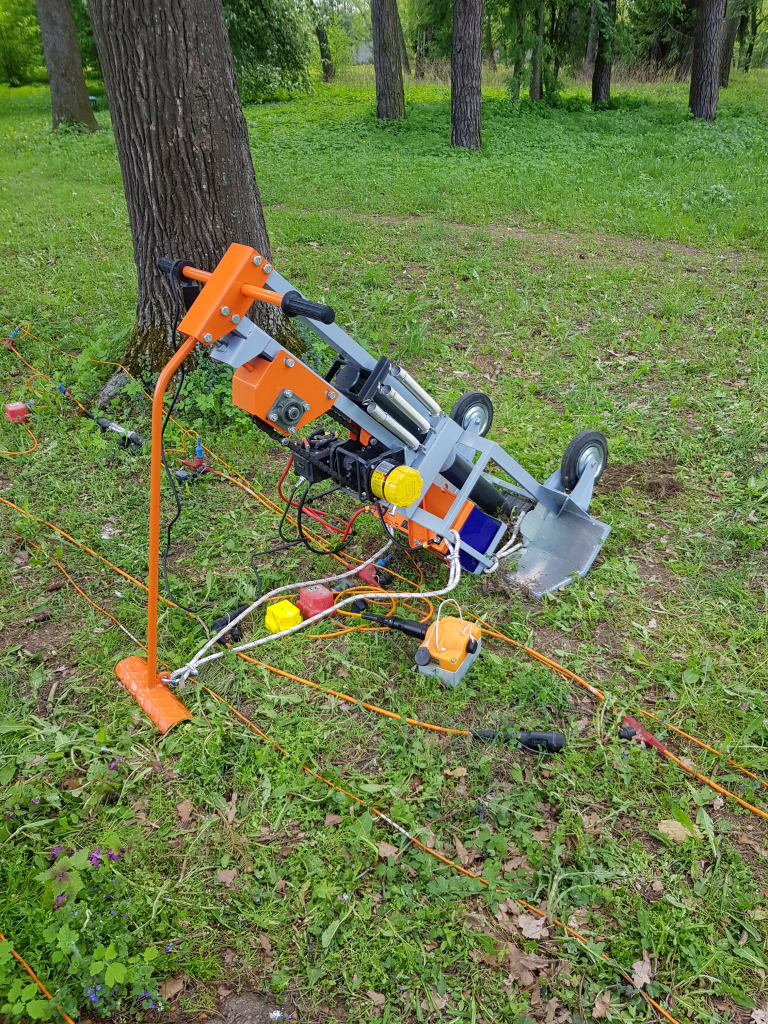
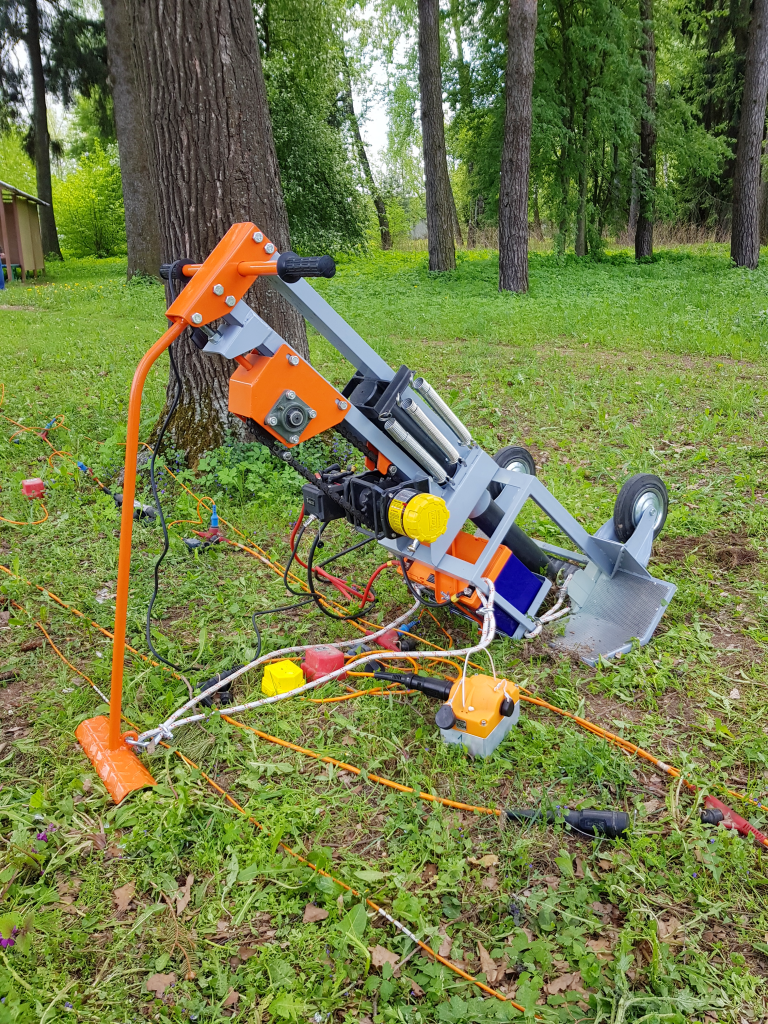
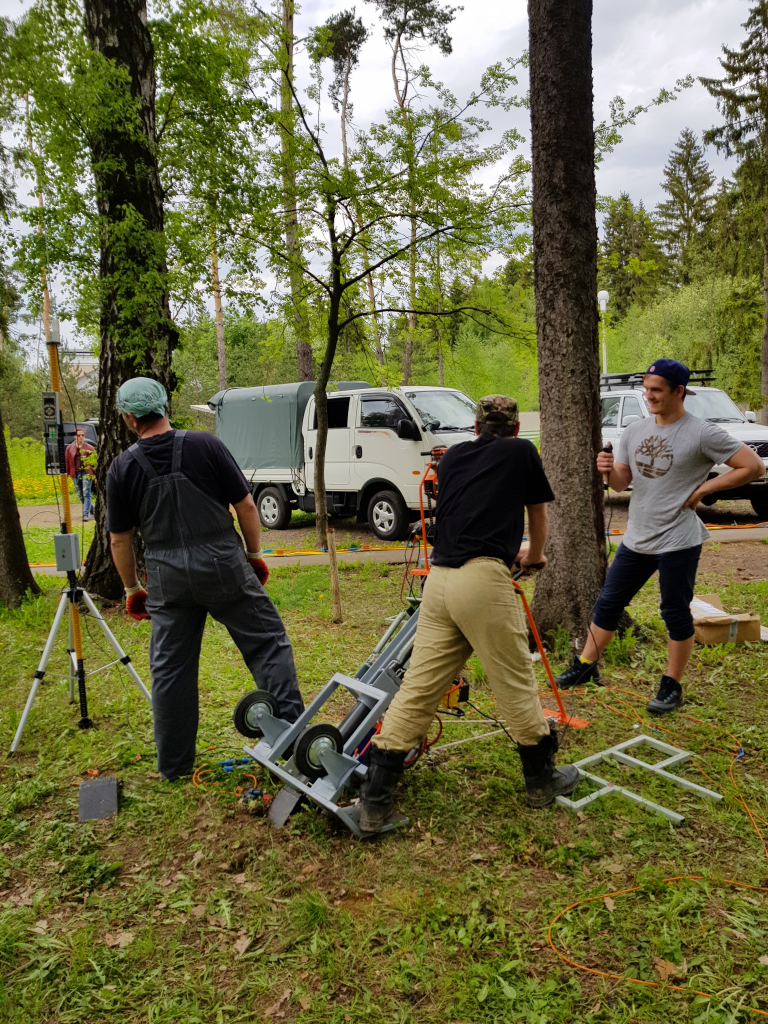
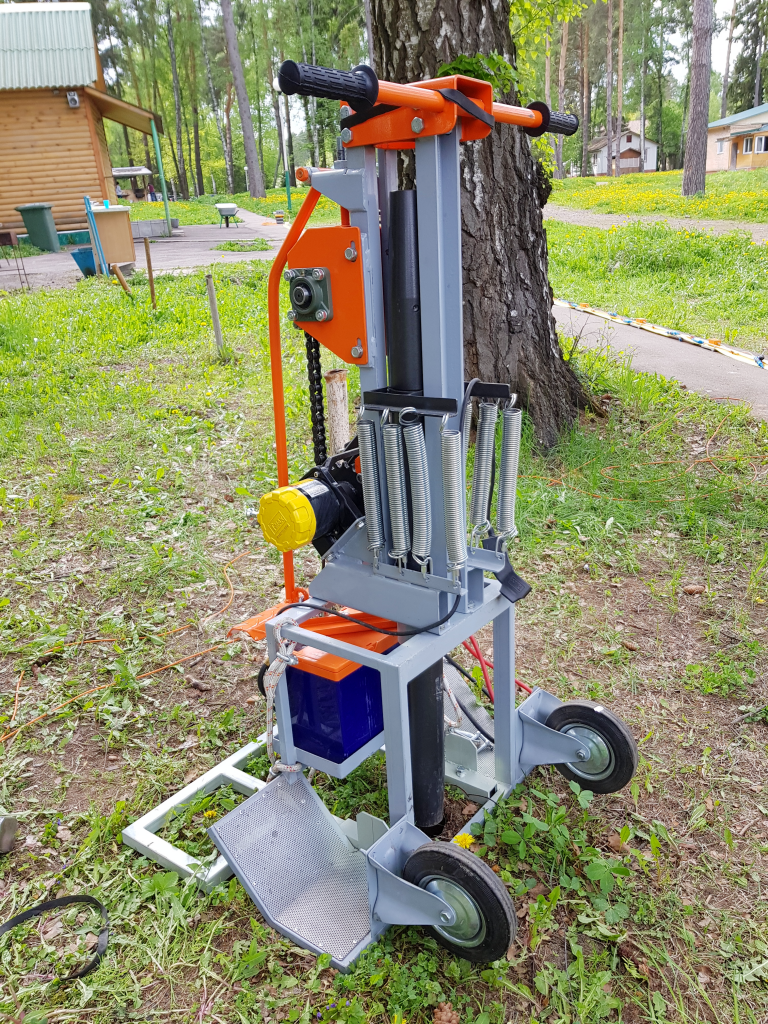
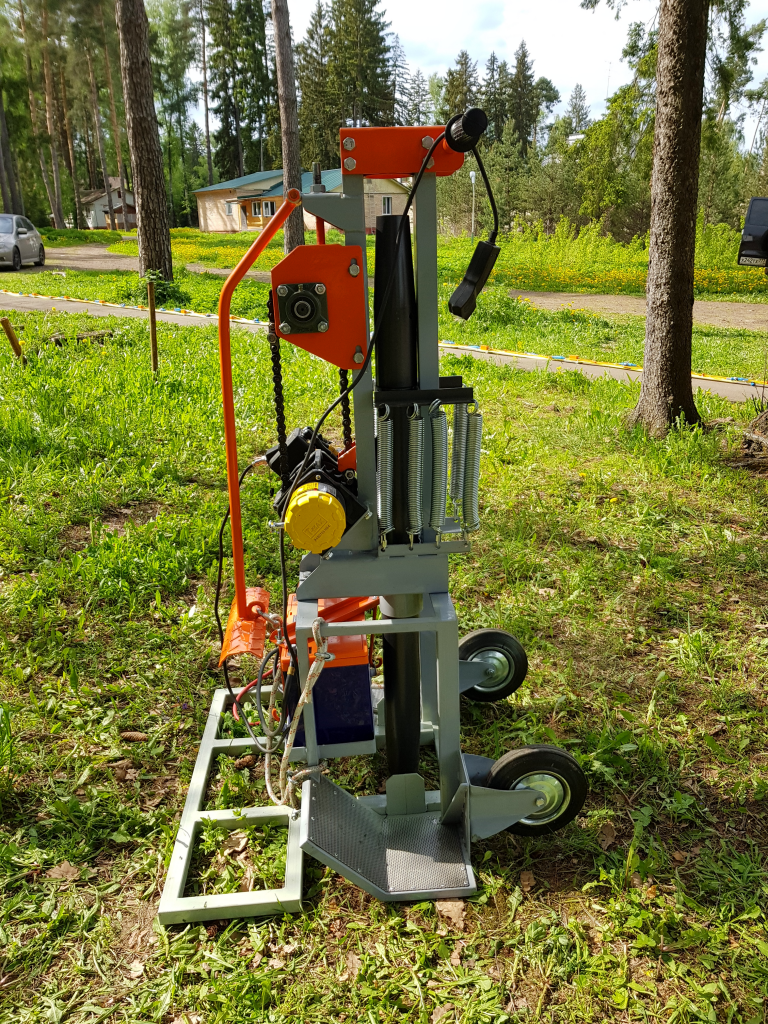
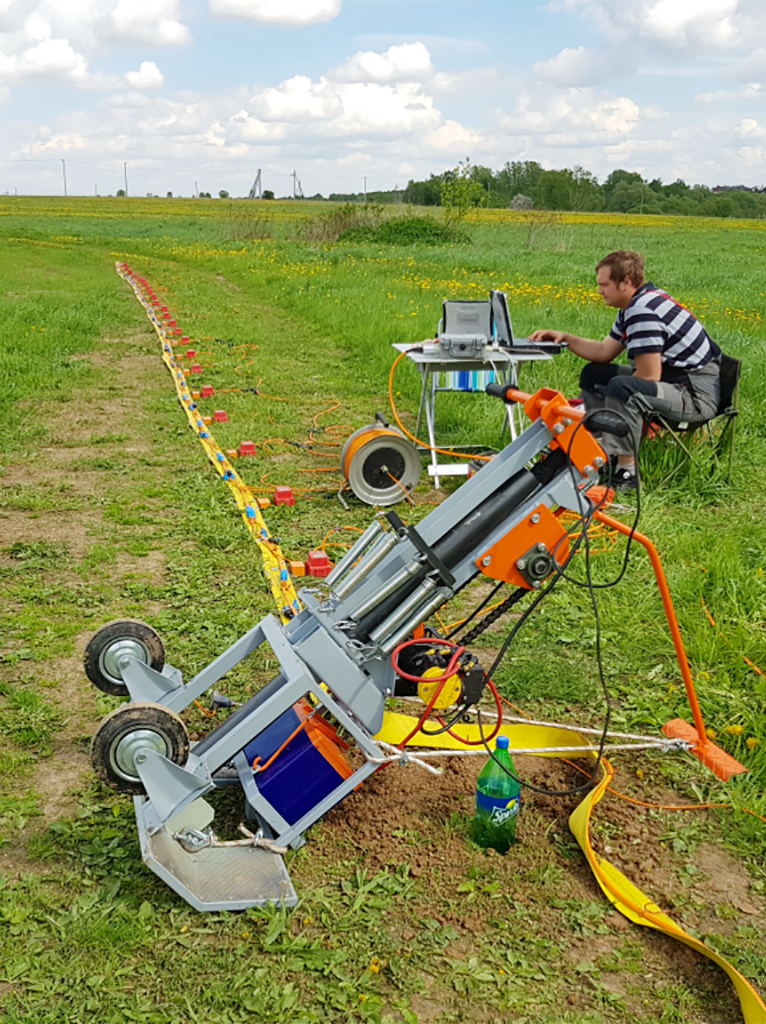
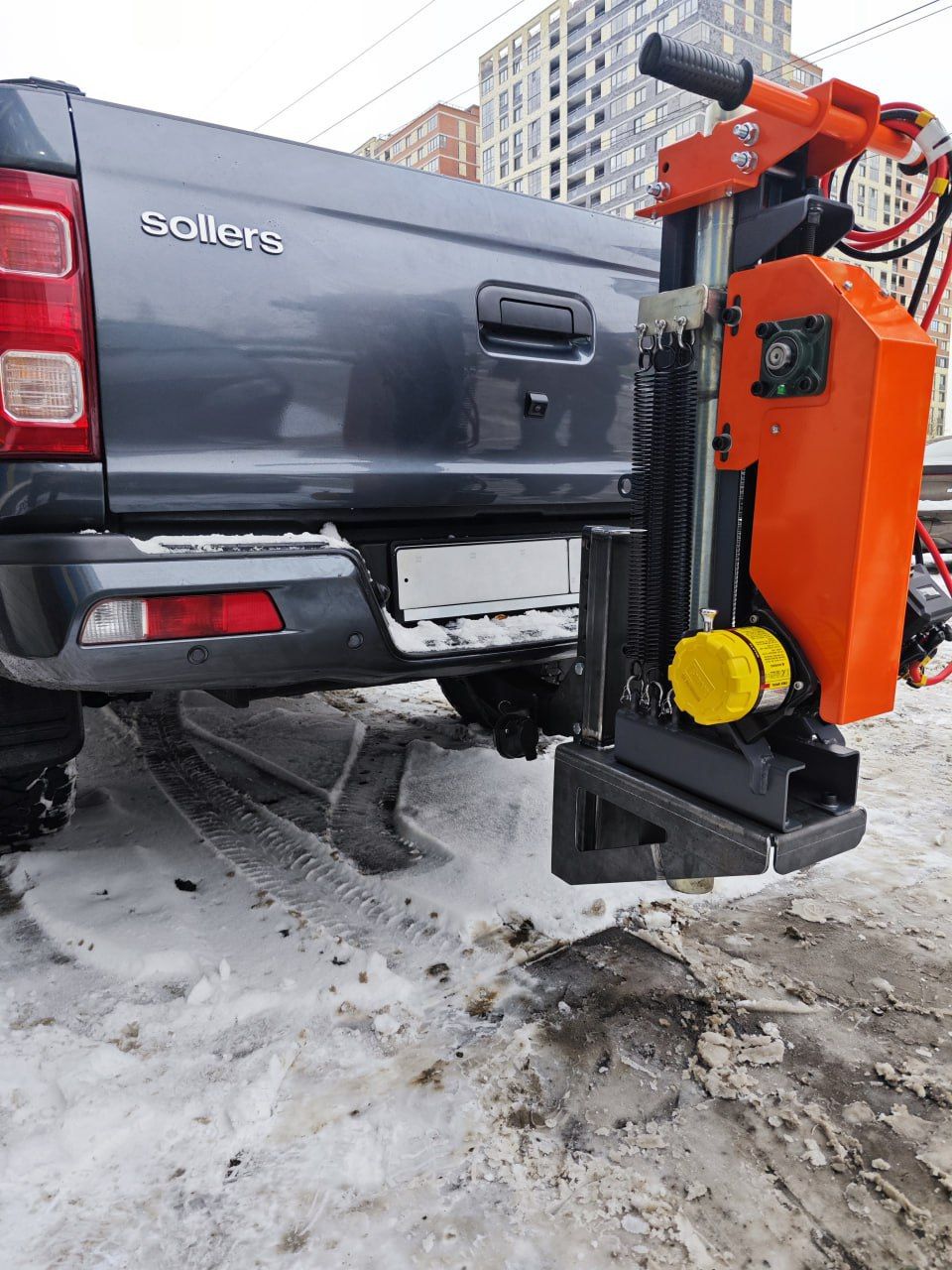
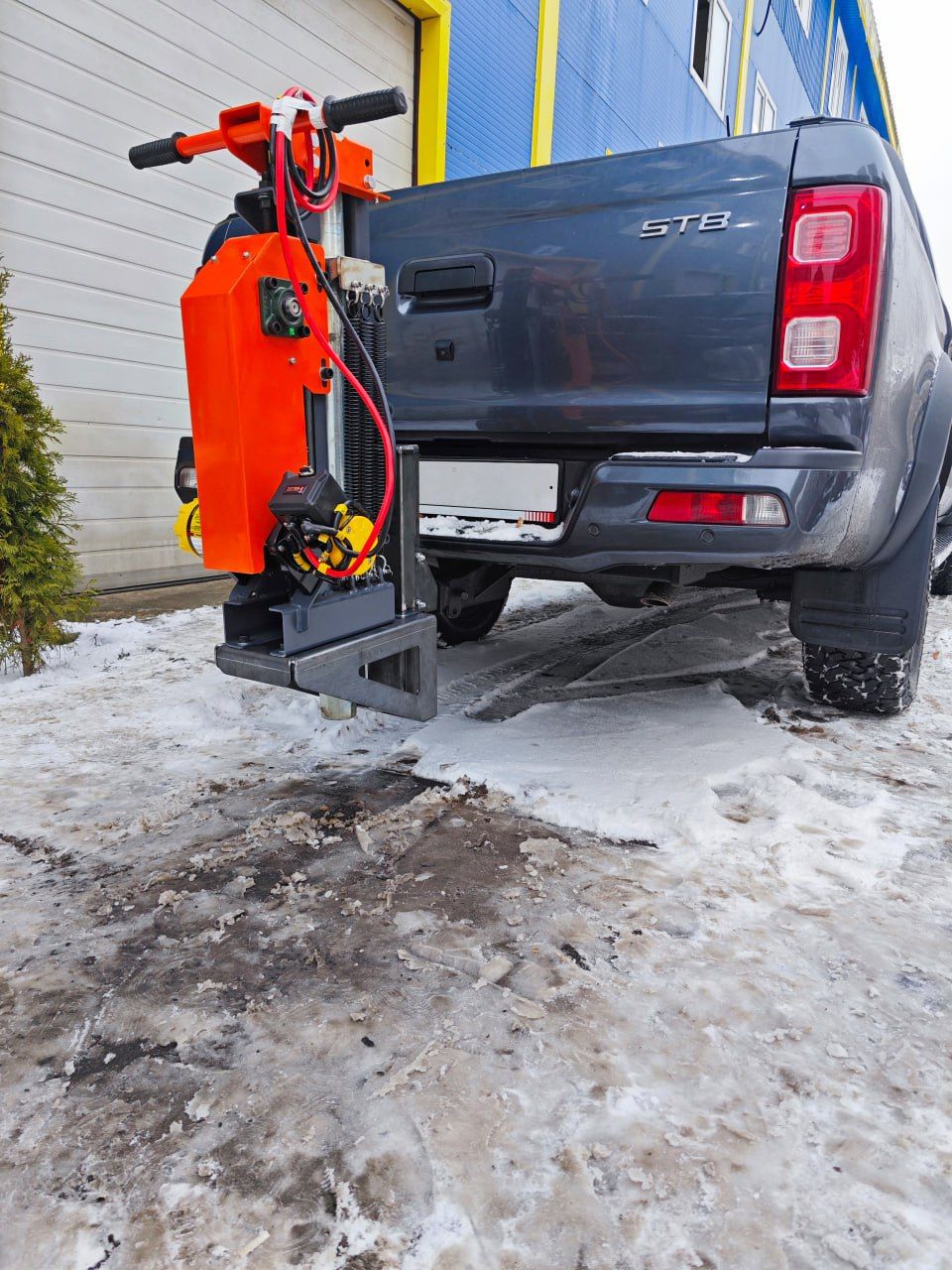
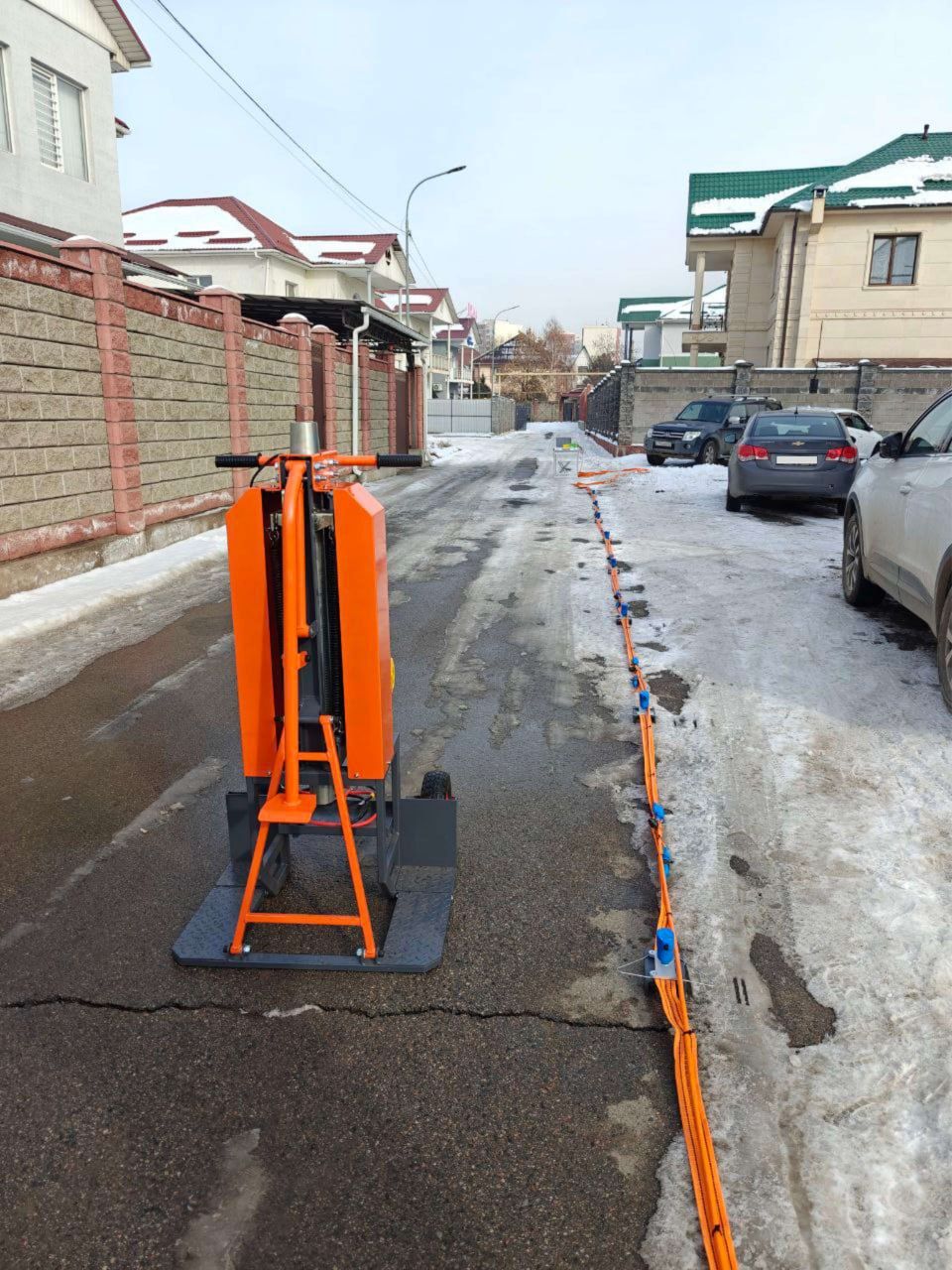
Accelerated weight drop seismic source AWD-40PS with cart:
Designed for efficient generation of P and S waves on land seismic surveys.
The set includes:
- Source AWD-40PS with 20, 30 or 40 kg hammer (on customer’s choice)
- Wired or wireless remote control
- Plate for inclined shots (S waves)
Accelerated weight drop seismic source AWD-40 with tow hitch adapter 2”:
Designed for efficient generation of P waves on land seismic surveys.
The set includes:
- Source AWD-40 with 20, 30 or 40 kg hammer (on customer’s choice)
- Wired or wireless remote control
- Tow hitch adapter (2-inch square)
Optional:
- Tow hitch adapter (2-inch square)
- Additional hammer for AWD of any weight – 20, 30 or 40 kg
- Hammer switch with 5m cable
- Titanium alloy plate for vertical shots (P waves)
- 12V 50Ah LiPoFe4 battery
- 12V 100Ah LiPoFe4 battery
- 5A charger for LiFePo4 or lead-acid battery
- 10A charger for LiFePo4 or lead-acid battery
- Cable synchronization system
- Wireless or GPS trigger switch
| Type of waves | pressure and shear |
| Minimum response time | 3 s |
| Weight (with additional hammer and battery) | < 120 kg |
| The energy of a single impact | 1000 J |
| Weight of additional hammer | 20/33/40 kg |
| Frame material | steel |
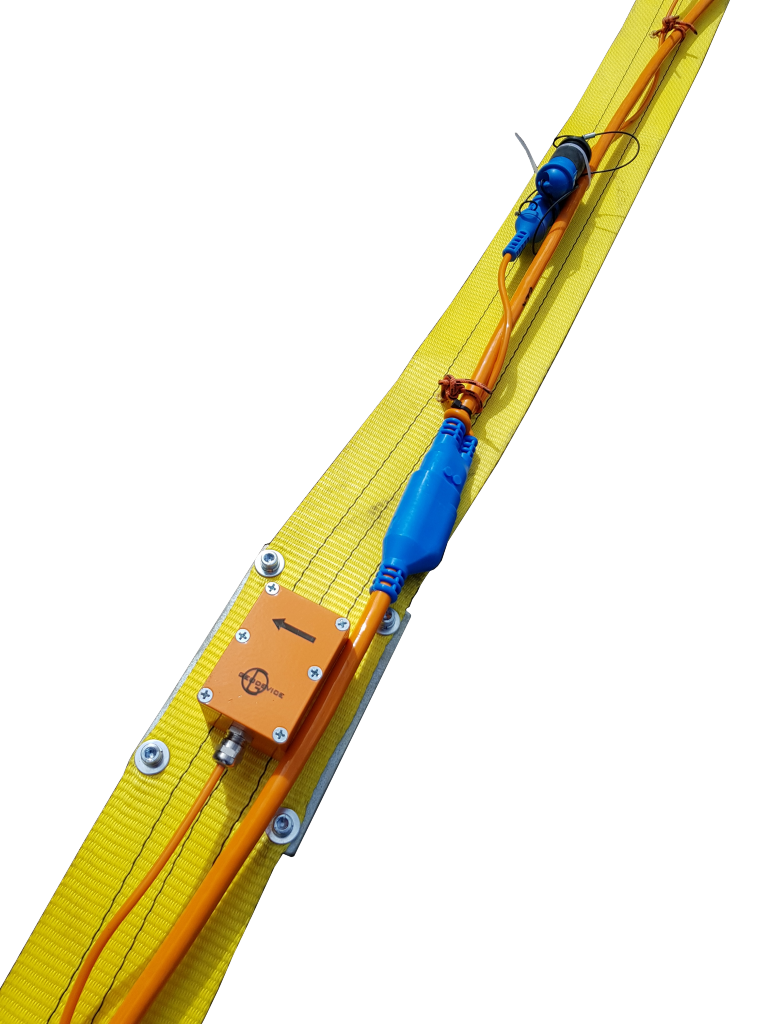

Titanium alloy plate for hammering
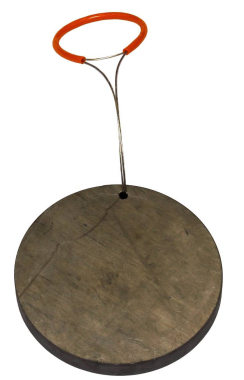
- 1.7 times lighter than steel
- Stays in use much longer than similar products
In seismic engineering surveys, a reliable and repeatable method to generate seismic waves is crucial for subsurface characterization. A common method involves striking a metal plate with a hammer, producing compressional and shear waves for geophysical data collection.
Titanium alloy plate has several advantages, over traditional steel or aluminum plates because it is:
- Lightweight
- Durable
- Portable
- Ergonomic
The titanium alloy plate is approximately 1.7 times lighter than comparable steel plates of the same dimensions. This is especially beneficial in difficult-to-access field sites.
Titanium alloys provide excellent resistance to corrosion and wear, resulting in a longer operational lifespan even under frequent, high-energy impacts.
The plate’s high stiffness and optimal thickness allows efficient mechanical energy transfer from the hammer to the ground, enhancing signal-to-noise ratio.
The plate is equipped with robust handle that is connected to the plate via steel cord, ensuring the plate can be carried securely and conveniently.
Application area:
- Shallow seismic reflection and refraction surveys
- MASW (Multichannel Analysis of Surface Waves)
- VSP (Vertical Seismic Profiling)
| Material | titanium alloy |
| Dimensions | 23×2,5 cm |
| Weight | 4,8 kg |
Sigma 4+ seismograph for surveys and monitoring
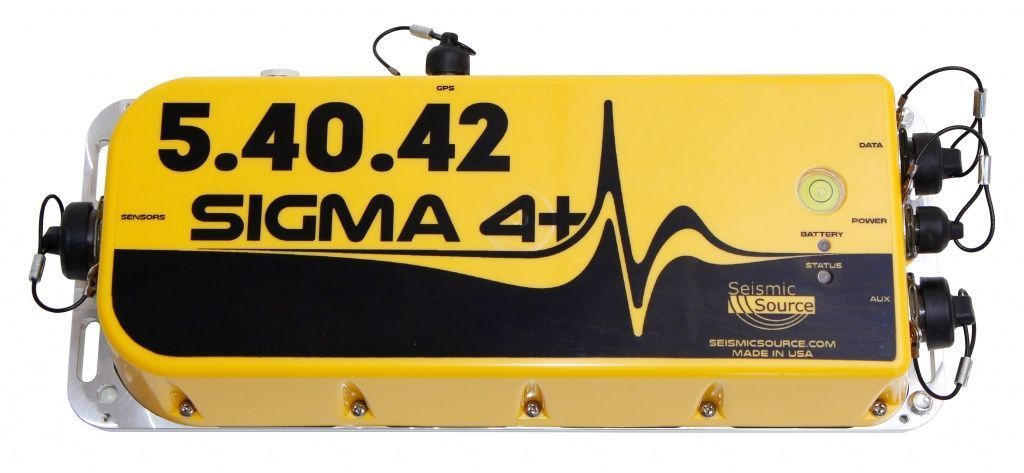
- Ideal for pile length tests and various other geotechnical applications
- Optimal for VSP and CST
- Continuous recording on a built-in or external memory
- Optimal for seismology, microseismic zoning, seismic monitoring and passive MASW
- Optional built-in 2 Hz 3C receiver
- IP67 protection
Sigma 4+ is a miniature 4-channel version of the DAQlink4 seismograph. Excellent metrological characteristics, continuous recording capability, high-frequency ADC, built-in or external GNSS receiver, remote access, optional built-in battery and 3C geophone, work with external low-frequency receivers, plug-in anemometer and much, much more, make this seismograph the best choice for the widest range of tasks.
The VSP with the GStreamer-E 3C probe or the WellStreamer hydrophone streamer
The Sigma 4+ is the optimal seismic seismograph for different methods of VSP, both for seismic waves velocity estimation along the borehole and for dynamic section plotting. Four recording channels allow performing observations with a 3C probe or a 3-channel hydrophone streamer and a reference geophone receiver, which provides the possibility of accuracy evaluation and correction of source-seismic seismograph synchronization error.
Parallel CST according to ASTM D4428 / D4428M
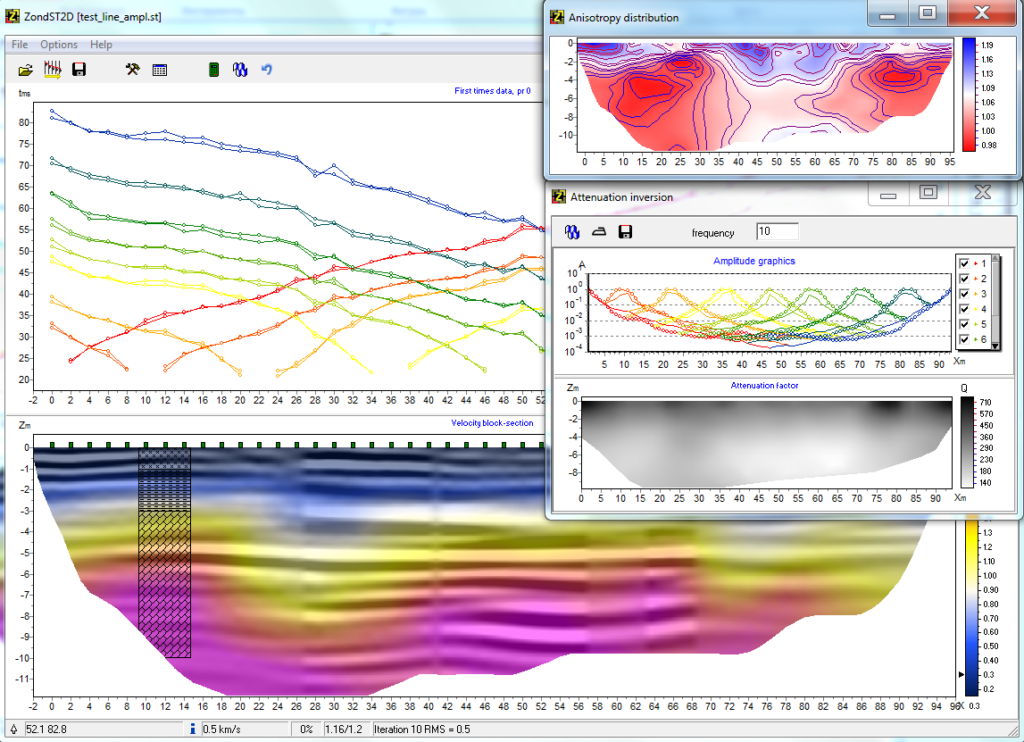
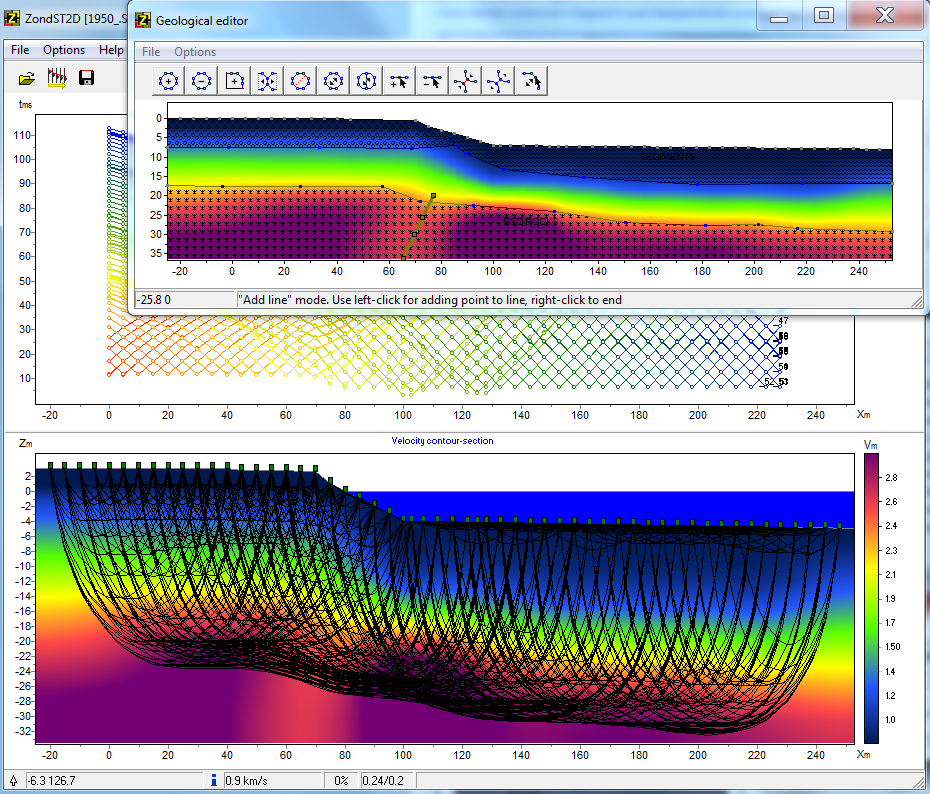
The method allows to reconstruct the velocity profile of P-waves and S-waves of rocks in situ with horizontal direction of waves propagation along the layer, i.e. without taking into account the velocity anisotropy related to thin layering (macroanisotropy) or geological formations consisting of small elements of two different substances (microanisotropy). Observations are performed in two parallel boreholes with a distance of 3 to 6 m between them. Generation of pressure (P) and shear (S) waves is executed using a borehole sparker Pulse and electrodynamic sources SHock and GeoSV. Signal receiving is provided by the GStreamer-E 3C probe and the WellStreamer hydrophone array. A description of CST technology can be found in ASTM D4428 / D4428M or in our publications.
Pile Length Testing, Base plate and Tunnel lining quality inspection
With its high-frequency ADC, the Sigma 4+ is perfect for almost any geotechnical task. For pile length testing (Pile Integrity Testing) and inspection of the footings (impact method), special high-frequency sensors GTSensor are connected to the seismograph. On foundation slabs, it is more convenient to use 4-channel LandStreamer towed seismic sensors as a receiver. The data can be processed in the GeoTechControl software.
Monitoring of microseisms, earthquakes, explosions, hydraulic fracturing and any other events
The seismograph allows continuous long-term data recording to built-in and external data storage devices with hot swapping capability without data loss. Timing is provided by a built-in or external GNSS receiver, a wired or wireless synchronization link between seismographs or by the seismograph’s internal high-stability clock. The Sigma 4+ can be optionally equipped with a built-in or external 2 Hz 3C seismic receiver, an internal battery and a detachable external low-frequency geophone. The seismograph case is equipped with a bubble level and has the possibility of screwing pins directly into its base. The Sigma 4+ is a perfect solution to perform any type of seismic monitoring, thanks to its dedicated software, multiple networking options, remote configuration and data download, continuous or auto-start recording based on a trigger signal or LTA (Long Term Average)/STA (Short Term Average) events with email notification capability.
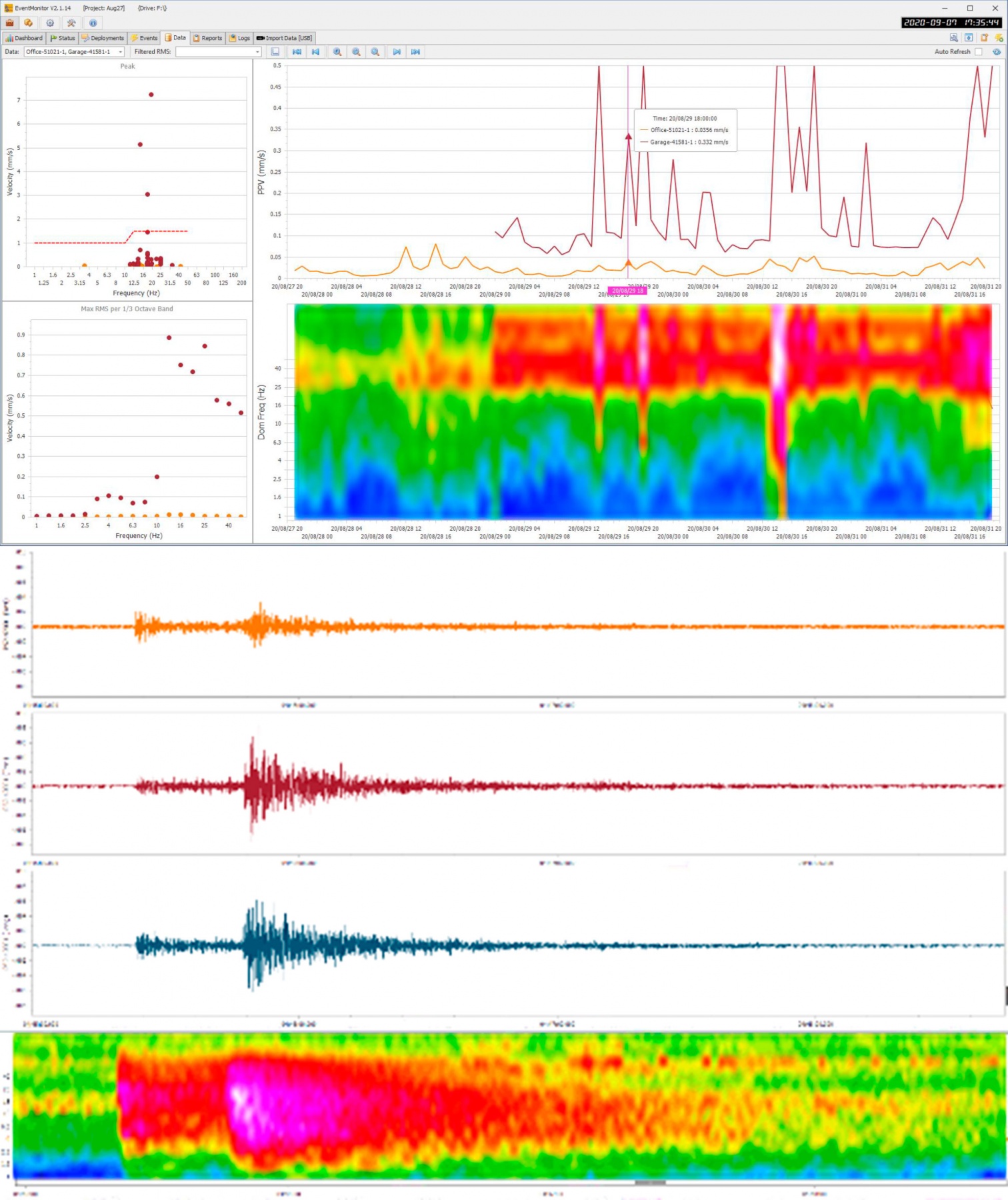
Passive MASW and the Nakamura method
The task of recording surface waves from stochastic or industrial sources as well as recording microseisms for subsequent calculation of H/V spectral ratios is successfully performed by the Sigma 4+ seismograph with an integrated or external mid-frequency (2 Hz) 3C sensor, connected external geophones (from 4.5 Hz) and low-frequency seismometers, accelerometers or torsional transducers.
Seismic survey in mines or dense urban building
It is not always possible to realize synchronization between the source and the seismograph. It can be extremely problematic or impossible to deploy a wired synchronization line between the mines or from the tunnel to the surface while testing, and using a radio channel in these cases is simply not feasible. Seismic surveys in the city often impose similar restrictions. DAQlink4 and Sigma 4+ seismographs can keep long-term records on the built-in and external storage with time reference from the GNSS signal and an autonomous high-stability clock. One seismograph can be connected to the receiving array and the other to the source for shooting log formation – this allows performing synchronization in post-processing, i.e. to slice standard seismograms from the data array.
High Resolution Marine Seismic
The fast and reliable Sigma 4+ and DAQlink4 high-frequency seismographs are excellent for 2D or 3D high-resolution marine seismic acquisition with the HRStreamer-1 towed streamer with a unique adjustable hydrophone array or the advanced 48-channel HRStreamer-48. A more complete description of the capabilities of the seismographs, towed water sources, and other necessary equipment can be found in a dedicated section. We also provide high-resolution marine data processing services.
Highlights of Sigma 4+ and DAQlink4 seismographs:
- Possibility to combine seismographs in a single array using twisted pair (length up to 3 km), Ethernet, Wi-Fi or GSM modems
- Any recording duration up to continuous recording
- Wide bandwidth of the recorded signal: 0 to 20,000 Hz
- Capability of remote control, setup, recording and data downloading via Wi-Fi, Gigabit Ethernet or cellular connection. Built-in FTP server
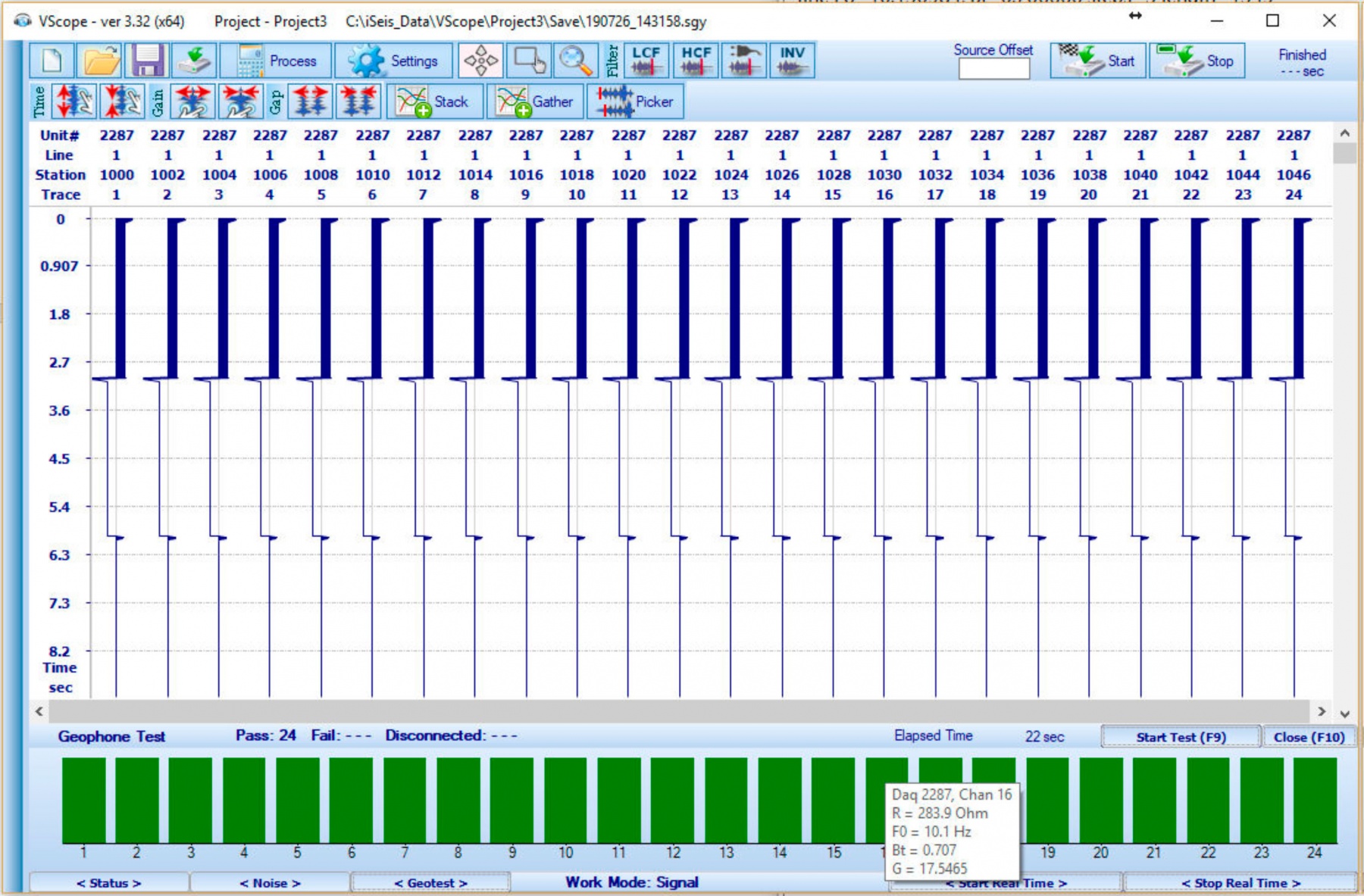
- Geophone test: frequency, impedance, attenuation and other features
- VHF / UHF radio or twisted pair wired synchronization (up to 3km) for use in mines
- Continuous logging with GNSS time synchronization
- Built-in 99.9 Wh battery
- Multiple triggering options: source sensor trigger, LTA (Long Term Average) and STA (Short Term Average) event, TTL pulse, and more. Even email notification is possible if an expected LTA or STA event is detected
- Register data from any type of source. Supports Force 3 controllers
- Built-in 16 GB memory for independent data recording and flash drive connection for data backup and transfer
- Built-in tools for seismograph test (distortion factor, mutual interference between the channels, common mode rejection, inherent noise level) and geophones test (impedance, frequency, attenuation, sensitivity)
- Data can be saved in the formats SEG-2, SEG-D, SEG-Y, ASCII or MiniSEED
Delivery set:
- Sigma 4+ seismograph
- Cable set
- Software
Additional options and peripheral accessories:
- 2 Hz 3C built-in or external low-frequency receiver
- Low-frequency seismometers, accelerometers and torsional transducers
- Wi-Fi option
- Mesh Radio Network module
- GSM modem
- High-frequency sensor GTSensor
- LandStreamer 4-channel array
- Pile Length Testing kit
- External USB data storage device
- Built-in or external GNSS receiver
- Built-in rechargeable battery (99.9 Wh)
- Solar panel
- Anemometer
- Marine and downhole seismic acquisition equipment
Software for Sigma 4+:
- Event monitor and Tremor cloud for microseismic surveys, seismic monitoring, earthquake recording, hydraulic fracture and injection monitoring
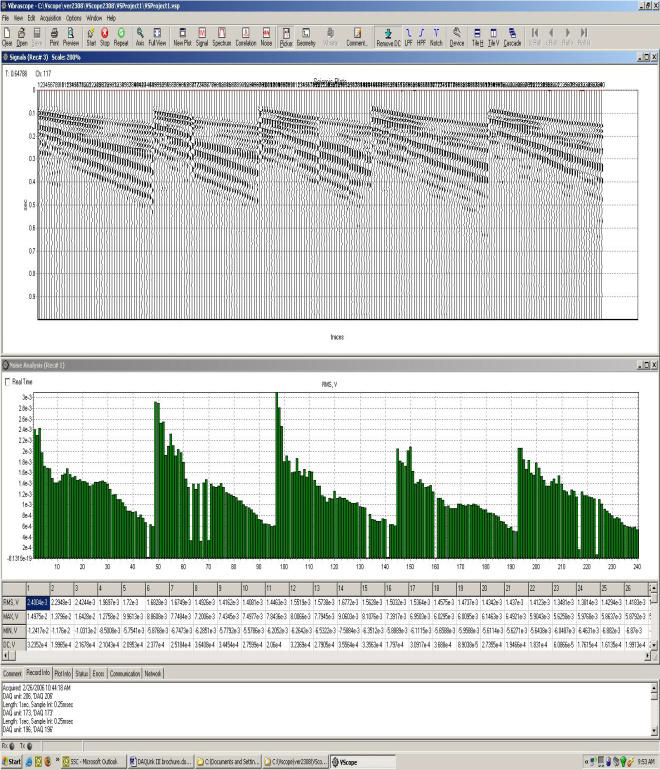
- Vscope and Bgr to collect data from different types of seismic sources
- DataCollection for data acquisition with track visualization
- Visualiser for data visualization and conversion to other formats
- Earthquake Locator for locating the epicenter
- Harvest for stacking
| Number of channels in one station | 4 ch. |
| ADC capacity | 24, Σ-Δ bits |
| Dynamic range | 127 dB (@ 500 Hz) |
| Preamplifier gain | ×1 (0 dB), ×4 (12 dB), ×16 (24 dB) |
| Sample rate | 125; 250; 500; 1000; 2000; 4000; 8000; 16000; 32000; 64000 Hz |
| Maximum record length | unlimited |
| Frequency range | 0 ÷ 20 000 Hz |
| Anti-aliasing filter | 80% of Nyquist frequency |
| High Pass Filter | 0.001 ÷ 120 Hz, digital |
| Filter type | linear-phase |
| Trigger accuracy | ±1 (@ 500 Hz) μs |
| Maximum input signal with minimum gain | ±3 V |
| The level of inherent noise of the registering channel | < 0.15 µV (@ 500 Hz) |
| Non-linear distortion coefficient | 0.0001 % (@ 500 Hz) |
| Mutual interference between channels | 125 dB |
| Common mode suppression factor | 100 dB (@ 500 Hz) |
| Power consumption | 0.4 W/channel |
| Input impedance | 100 kOhm |
| Time synchronization | GNSS receiver or VHF |
| Data storage capacity (16 Gb CF internal memory) | 720 hours (4 channels @ 500 Hz, 16 Gb) |
| Maximum capacity of external USB flash drive | up to 2TB |
| Hot swap external USB drive without data loss | yes |
| Data format | SEG-2, SEG-D, SEG-Y, ASCII, MiniSEED, SEEDlink |
| LEDs | 2 LEDs for displaying battery status and operating mode |
| Power | 10 – 28 V DC |
| Temperature range | -40 ÷ +80 °C |
| Operating humidity | 0 ÷ 100 % |
| Dimensions | 360×150×75 mm |
| Weight without additional extensions | 1.5 kg |
| Possibility of optional installation of devices and sensors | – GNSS receiver- 2 Hz 3C geophone- rechargeable battery 99.9Wh- single-board computer with Linux for real-time data processing, acquisition or transmission via radio channel (Linux option)- solar panel |
| External devices connectivity | external USB storage device, radio access point, Wi-Fi module, GSM modem, GNSS receiver, anemometer |
| Connectors | – 26 pins for geophones, ADC calibration and built-in sensors- 4 pins for external GNSS receiver- 10 pins for Ethernet connection- 3 pins external power supply- 19 pins for external USB drive or trigger lineOptional:- USB for cloud storage connection (Linux option) |
DAQlink 5 seismograph for surveys and monitoring
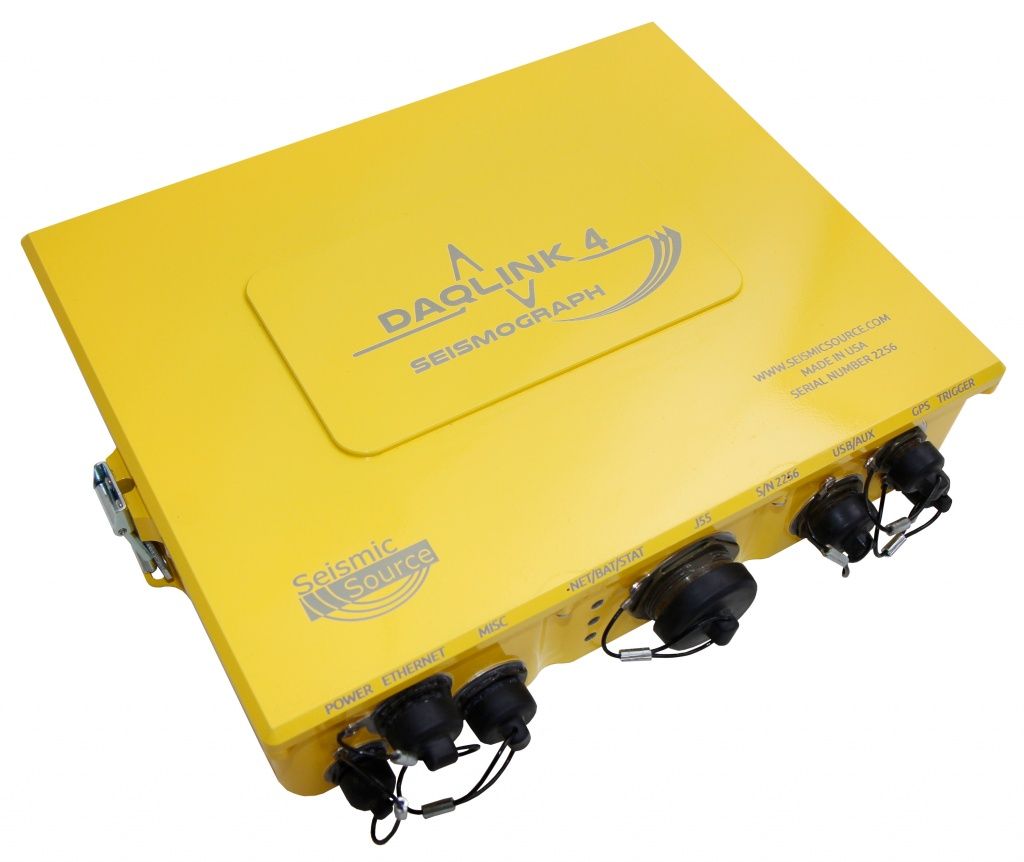
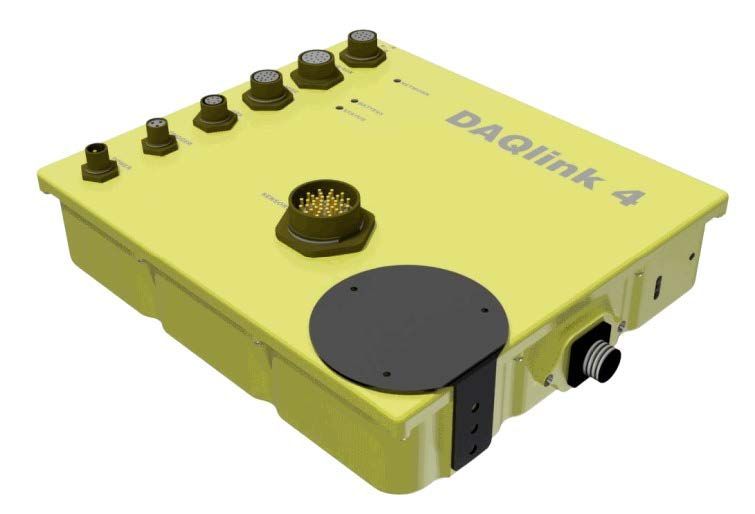
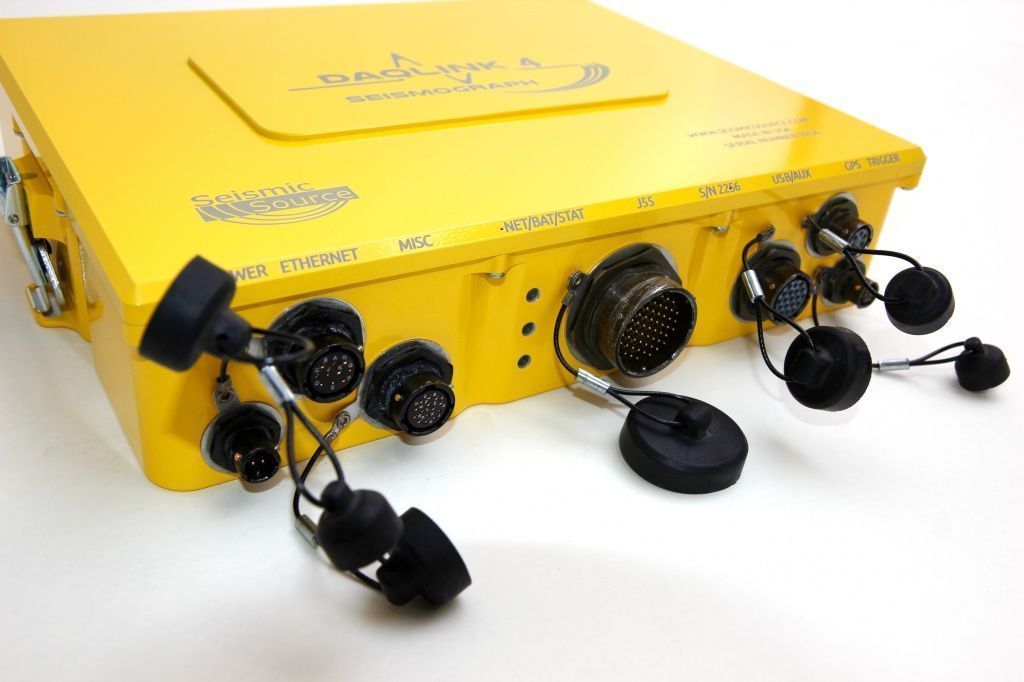
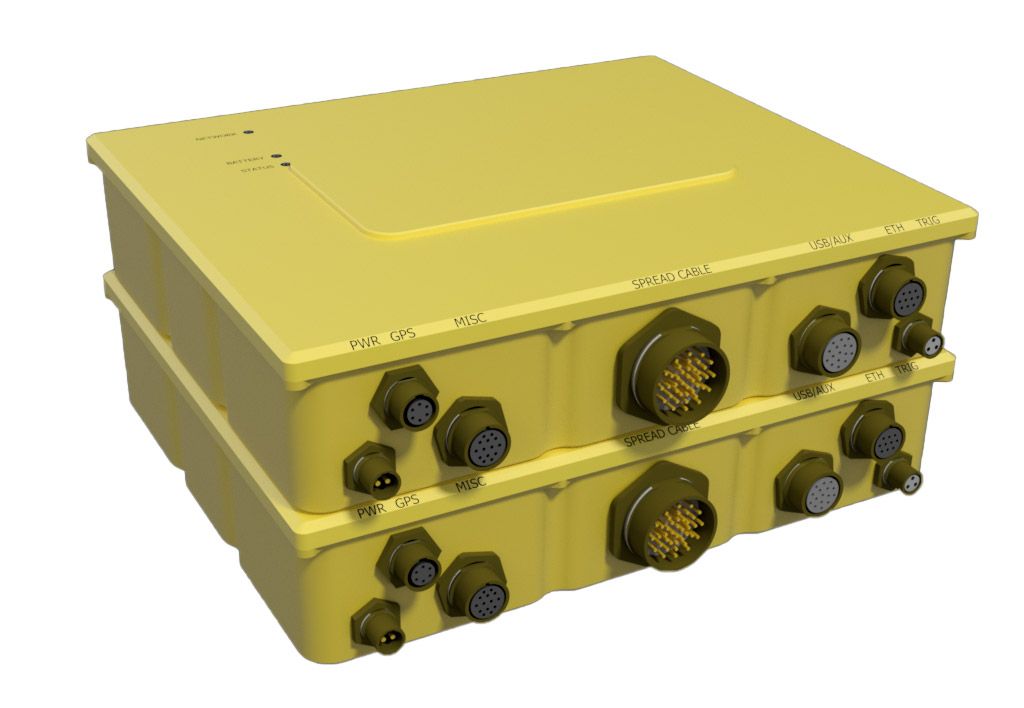
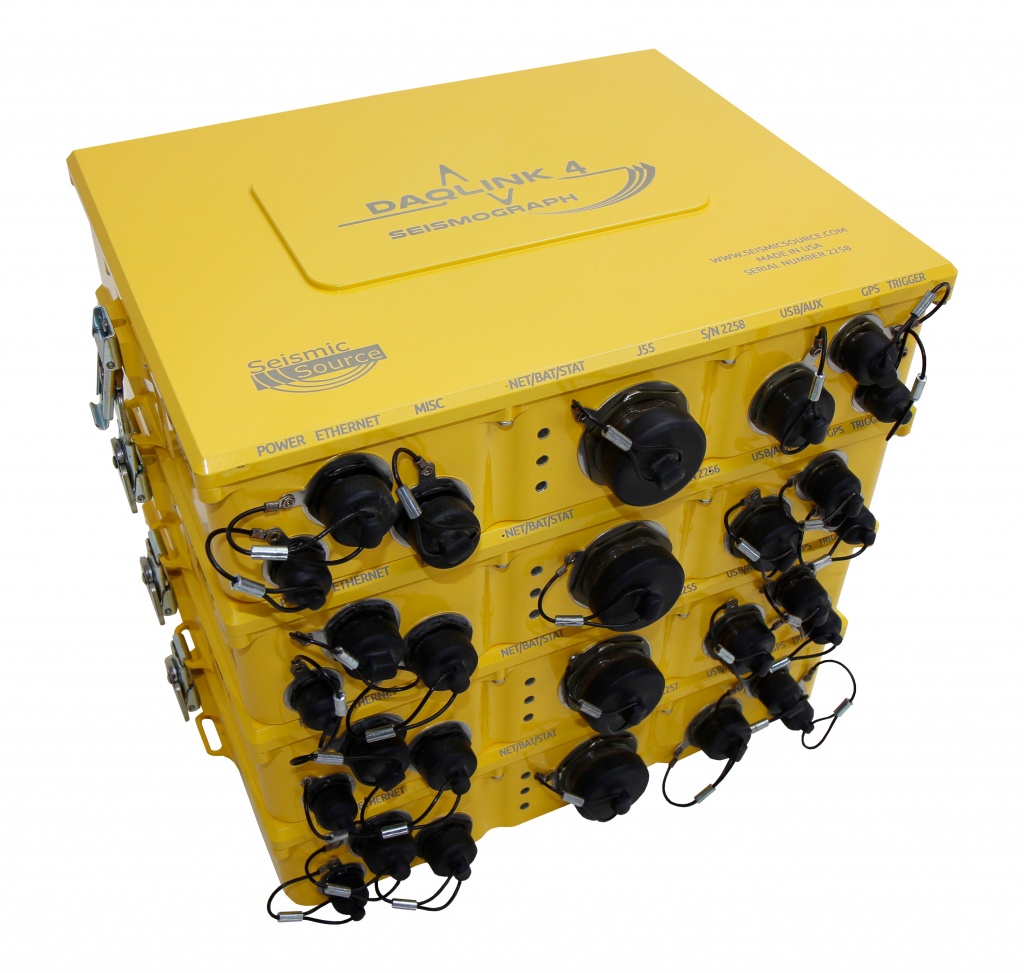
- All types of surveys, including monitoring, and passive MASW
- Easy station pooling
- Stand-alone recording
- Remote operation via Wi-Fi, GSM, GbE
- Built-in GPS
DAQlink-5 is a portable inline seismic seismograph that provides seismic surveys with any methods on land, in boreholes and in the water area. The possibility of continuous data recording allows using the seismograph as a stand-alone recording system for seismic monitoring or passive MASW.
The number of channels in one recorder could be 6, 12, 24 or 48, but the system configuration allows increasing their number by linking the seismographs through cable lines up to 3 km long, which are used for time synchronization in the modules and data exchange between them. When using the seismograph as a stand-alone recorder, time synchronization of the units is carried out through a GPS receiver, and in the case of operation in mines and tunnels it is maintained through a built-in clock or with the help of a VHF radio modem.
Features of DAQlink-5:
- Ability to link seismographs in a single array using twisted-pair cable (length up to 3 km), Ethernet, Wi-Fi or GSM modems
- Any recording duration up to continuous recording
- Wide bandwidth of the recorded signal: 0 to 20,000 Hz
- Capable of remote control, setup, registration and data downloading via Wi-Fi, Gigabit Ethernet or cellular connection. Built-in FTP server
- VHF / UHF radio or twisted pair wired synchronization (up to 3km) for use in mines
- Continuous recording with GPS time synchronization
- Multiple trigger options for recording: by source trigger sensor signal, LTA (Long Term Average) and STA (Short Term Average) event, TTL pulse and others. Even email notification if an expected LTA or STA event is detected
- Data registration for all kinds of sources. Supports Force 3 controllers
- Built-in 16 GB memory for stand-alone data recording and flash drive connection for data backup and transfer
- Built-in tools for testing seismographs (distortion factor, mutual interference between the channels, phase suppression, inherent noise level) and geophones (impedance, frequency, attenuation, sensitivity)
- Data can be stored in the formats SEG-2, SEG-D, SEG-Y, ASCII or MiniSEED
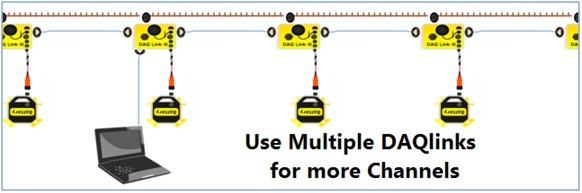
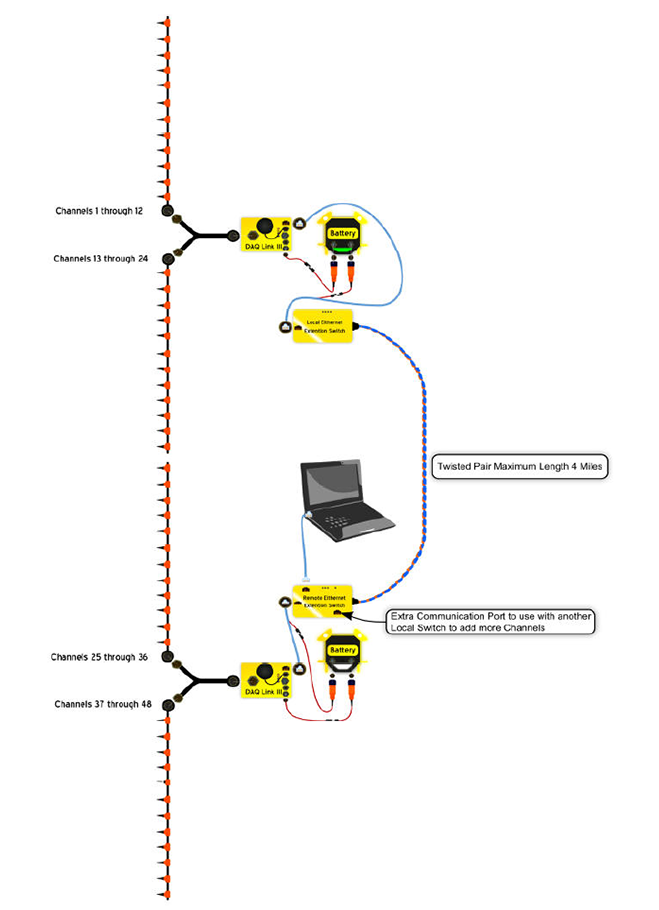
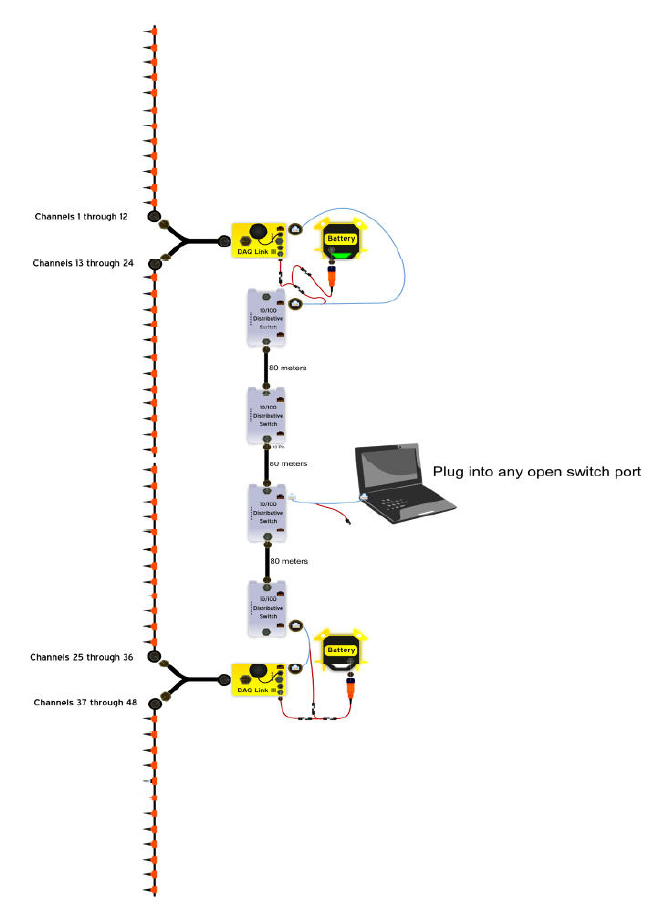
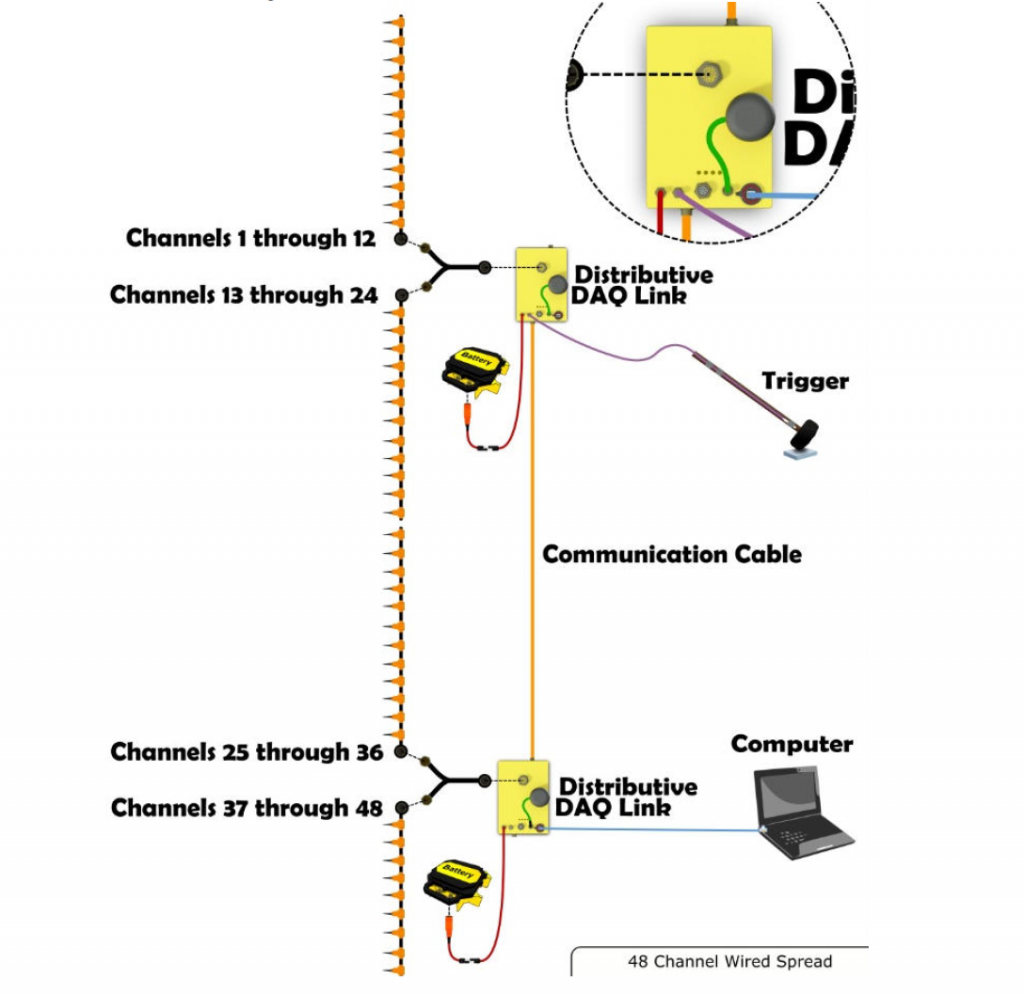
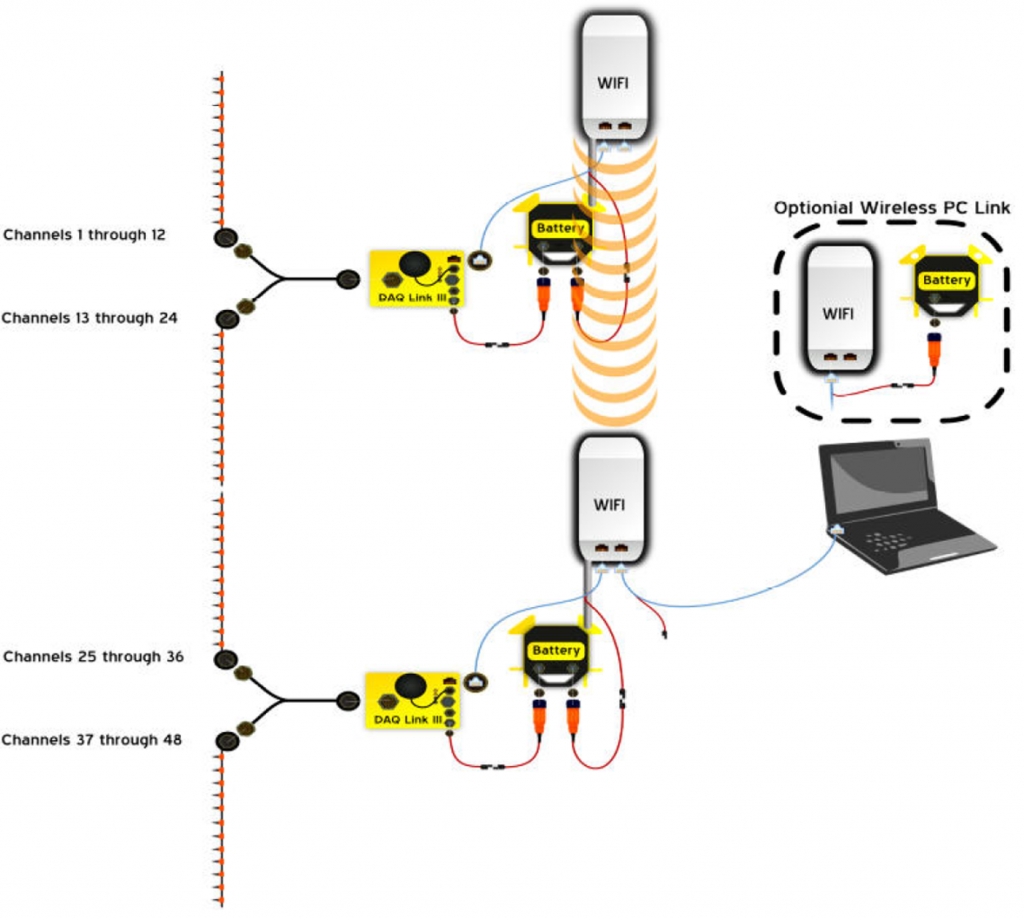
Several seismographs can be linked together into a single recording array using different wired or wireless interfaces. There are so many ways to connect that only a few of them are listed here.
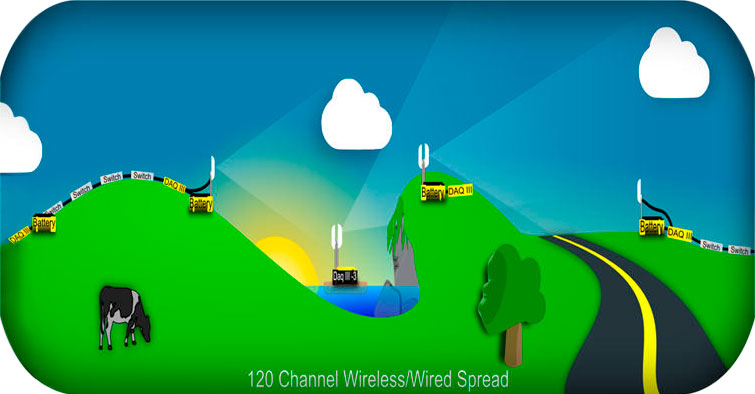
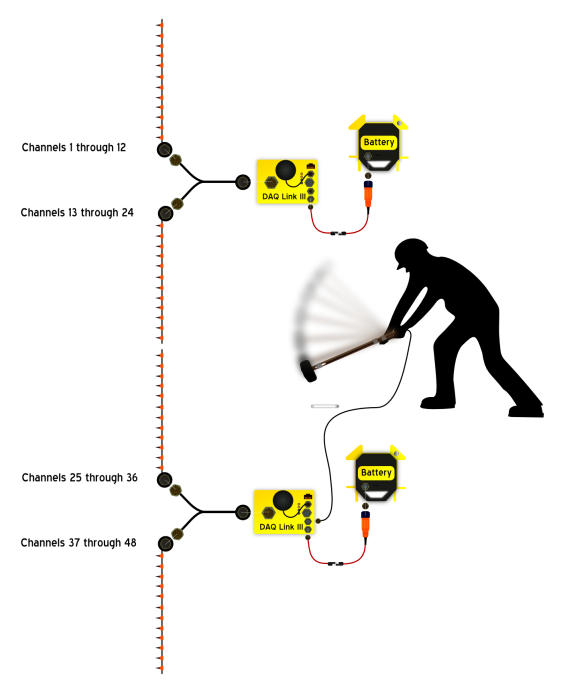
Several DAQLink 5 can also work in a fully stand-alone mode without a network connection or connected computers. The data are recorded on the built-in memory of GPS-synchronized seismographs and can be downloaded after the work is completed. CSP seismograms are created later using the Harvest software.
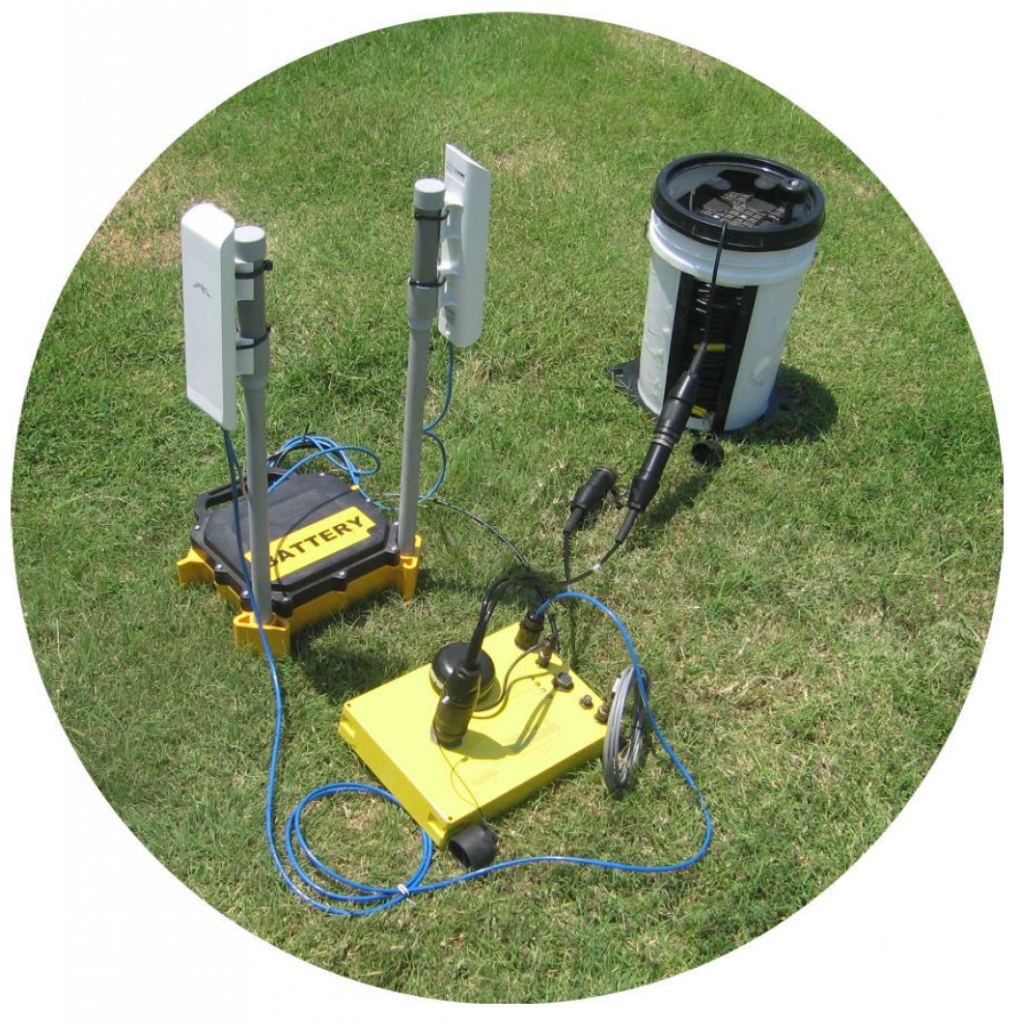
DAQlink with two directional Wi-Fi antennas
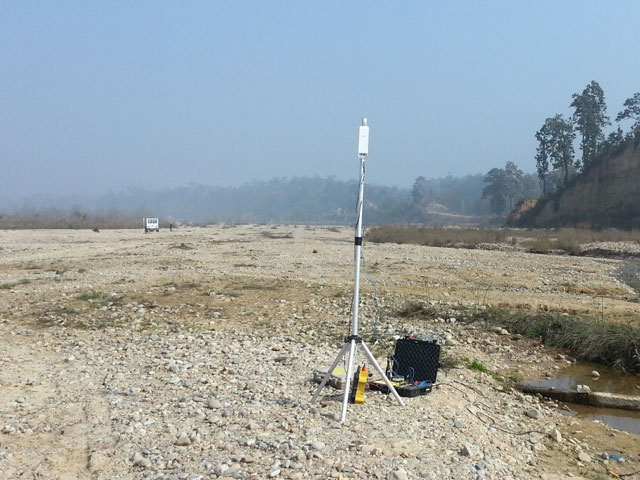
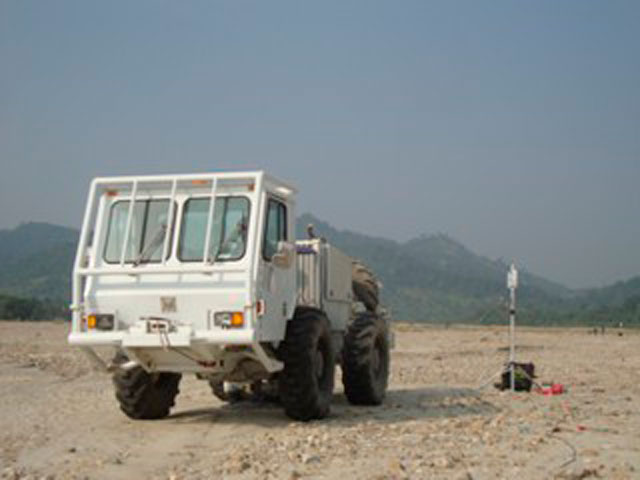
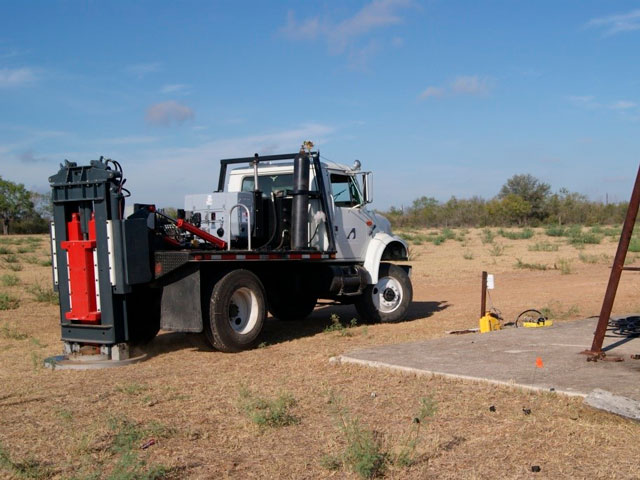
Work with vibrators or pulse sources. Nodal shooting.
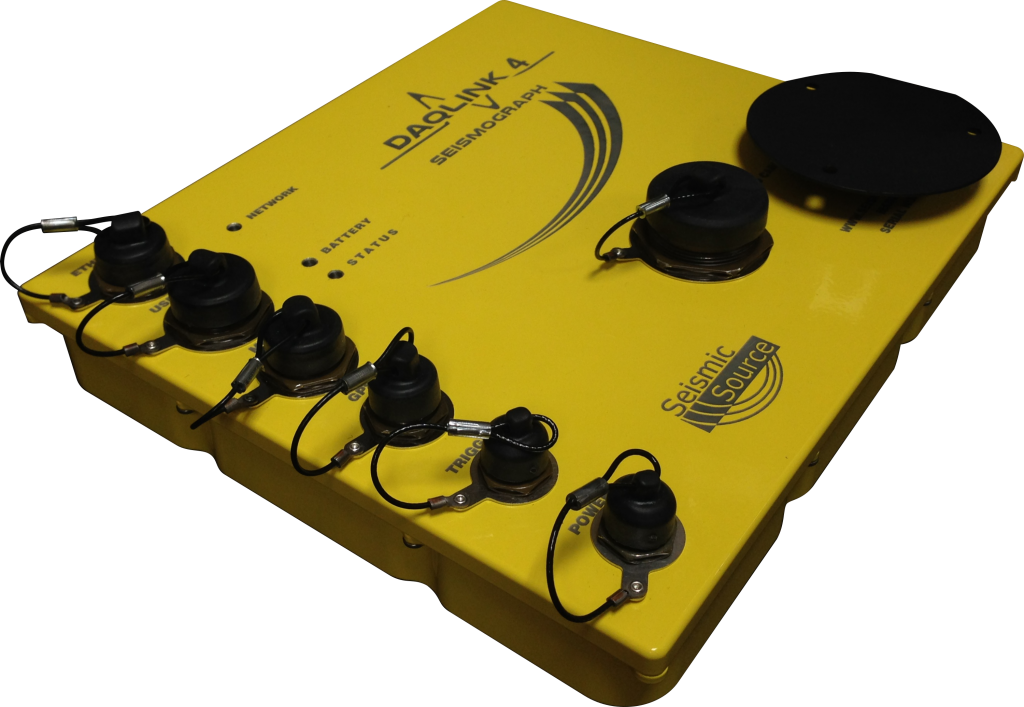
Standard version with top panel connectors
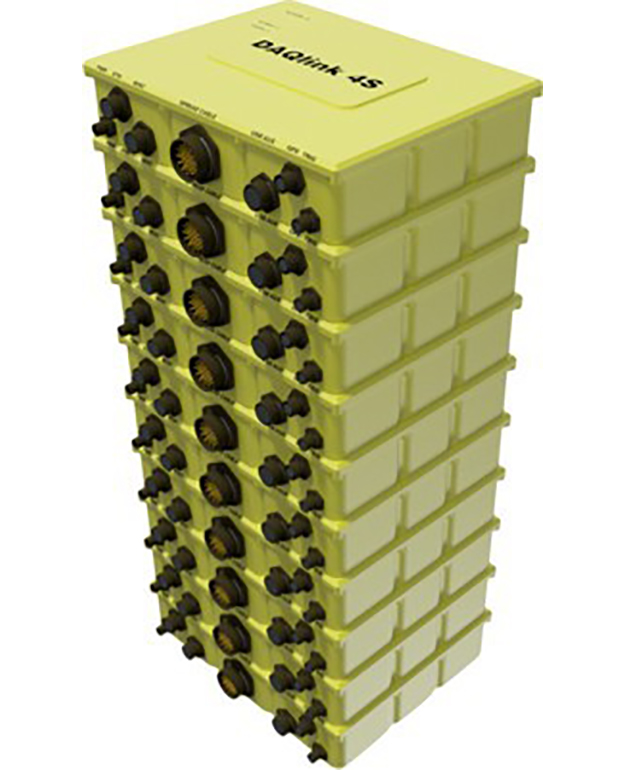
The side placement of the connectors is convenient for linking the seismographs into a single array.
In addition to the DAQlink 5 seismograph the following items can be purchased:
- Seismic cables
- Seismic receivers
- Sources
- Synchronization systems
- Computer software
| Number of channels in one station | 6, 12, 24, or 48 |
| ADC capacity | 24, Σ-Δ bits |
| Dynamic range | 124 dB (@ 500 Hz) |
| Preamplifier gain | ×1 (0 dB), ×4 (12 dB), ×16 (24 dB) |
| Sample rate | 125; 250; 500; 1000; 2000; 4000; 8000; 16000; 32000; 64000 Hz |
| Frequency range | 0 ÷ 20 000 Hz |
| Anti-aliasing filter | 85% of Nyquist frequency |
| High Pass Filter | 0.001 ÷ 120 Hz, adjustable |
| Filter type | linear-phase |
| Trigger accuracy | ±1 (@ 500 Hz) μs |
| Maximum input signal with minimum gain | ±3.7 V |
| The level of inherent noise of the registering channel | < 0.2 µV (@ 500 Hz) |
| Non-linear distortion coefficient | 0.00008 % (@ 500 Hz) |
| Mutual interference between channels | -125 dB |
| Common mode suppression factor | 100 dB (@ 500 Hz) |
| Power consumption | 0.13 W/channel |
| Input impedance | 100 kOhm |
| Time synchronization | GNSS receiver or VHF radio |
| Data storage capacity (16 Gb CF internal memory) | 120 hours (24 channels @ 500 Hz, 16 Gb) |
| Maximum external memory capacity (Ethernet or USB) | unlimited |
| Data format | SEG-2, SEG-D, SEG-Y, ASCII, MiniSEED |
| LEDs | Ethernet, battery status, and operating mode |
| Power | 10 – 28 V DC |
| Temperature range | -40 ÷ +85 °C |
| Operating humidity | 0 ÷ 100 % |
| Dimensions | 245х340х75 mm |
| Weight | 3.135 kg |

Equipment & Software for Geophysical Surveys: Design, Manufacture, Support, Supply
GEODEVICE is a group of specialized companies that develops, manufactures, and supplies
advanced geophysical equipment and software for a wide range of applications, from land-
based surveys to marine and borehole explorations.
The key areas of GEODEVICE developments are high and ultra-high resolution marine seismic,
borehole seismic, land, drone and marine magnetic.
The focus is on a broad range of industries and scientific fields, providing tailored solutions for:
- Geotechnical Monitoring
- Engineering Surveys
- Environmental Surveys
- Archaeological Surveys
- Geophysical Support for Geological Exploration
Let’s Connect
Need assistance? Get in touch with our team.